
Latest News
France is lobbying for Russia to face energy sanctions


The European Parliament has approved a bill that would make it easier for people to travel All 27 European Union countries are “totally determined” to impose sanctions on Russia, which could target oil and coal, according to French Finance Minister Bruno Le Maire.
Because Europe relies on Russian oil, gas, and coal, reaching an agreement on energy policy is difficult, but reports of the killings outside of Kyiv have heightened calls for stiffer EU sanctions.
Europe has been hesitant to target Russian energy because of fears that it would send the European economy into a tailspin. In some ways, going without Russian oil would be easier for Europe than going without Russian gas because most supplies are delivered by tankers and could be obtained from other sources. However, speculation about a possible boycott of Russian oil has pushed up global oil prices this week.
When asked if there was political will to impose sanctions on Russian oil and coal, as French President Emmanuel Macron suggested this week, Le Maire said, “We’ll see what the other member states’ positions are, but I think there’s a possibility of having unity on the 27 member states on these new sanctions.”
He made no mention of natural gas and reaching an agreement on how to target the fuel used to generate electricity and heat houses would be considerably more challenging. The EU imports nearly 40% of its natural gas from Russia, and many EU members, particularly Germany, the bloc’s largest economy, reject a gas embargo.
France currently holds the EU Council presidency, and Le Maire spoke ahead of a meeting of EU finance ministers in Luxembourg, where they will debate further sanctions against Russia.
While the EU has so far refrained from punishing Russian energy, individual nations have announced measures to reduce their reliance: Poland has said it would stop importing Russian coal and oil, while Lithuania has indicated it will no longer use Russian natural gas.
The European Union imports roughly 25% of its oil from Russia, and in 2020, the EU imported 53% of its hard coal from the country, accounting for 30% of the EU’s hard coal usage.
Although coal and oil may be on the table, Teresa Ribera, Spain’s Minister for the Environment, said Tuesday that sanctioning Russian natural gas would be “extremely difficult” because several EU countries rely on it for energy and that the EU’s strength resides in its unity.
“It’s really difficult to explain to European public opinion and Ukrainian society why we’re still importing Russian energy, which funds this war,” she said, adding that energy imports cause “clear moral tension.”
Russian fossil fuel is largely delivered by permanent pipeline, making it more difficult to replace it with expensive and rare liquefied natural gas supplies. While oil is less difficult to obtain than gasoline, abandoning it would have ramifications.
For one thing, the consequent price hikes for other oil could encourage India and China, which aren’t subject to Western sanctions, to purchase cheaper Russian petroleum. Russia is also a key supplier of diesel fuel; if that supply is cut off, running diesel-powered trucks and farm equipment might become prohibitively expensive, adding to Europe’s already high inflation.
According to commodities analysts at German bank Commerzbank, oil prices surged as buyers looking to avoid Russian oil bid for restricted supplies from other producers such as Saudi Arabia.
Brent, the international benchmark, climbed 3% on Monday and was trading above $108 per barrel on Tuesday, up 1%. On Tuesday, US crude jumped 1.1 percent to $104.37. Crude prices have fallen after US President Joe Biden stated last week that 180 million barrels of oil will be released from strategic stockpiles over the next six months. Drivers in the United States will pay more for fuel as oil prices rise.
The European Commission, the EU’s executive arm, will develop the next set of EU sanctions, which will be presented to EU governments for approval.





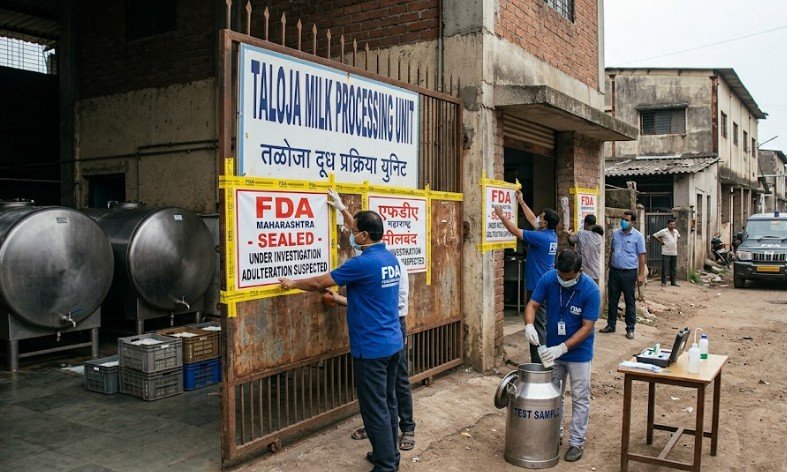
Authorities destroy 1,494 litres of suspected adulterated milk and register a criminal case against six people following inspections in Panvel.
The Adulteration
The Food and Drug Administration (FDA) has suspended the licences of three dairy units in the Taloja industrial area of Panvel following inspections that reportedly revealed violations of food safety and hygiene standards. The action was taken against Mateshwari Foods, Sawariya Milk and Milk Products, and Royal Foods, located in Balaji Industrial Park, Taloja.
During the inspection, FDA officials destroyed 1,494 litres of suspected adulterated milk and seized curd for further examination. Samples have been sent for laboratory testing, and further action will depend on the test results. A criminal case has also been registered against six people at Taloja police station. They are accused of involvement in the production, storage and sale of adulterated food products, raising concerns about the safety of dairy products supplied to consumers.
The FDA’s action highlights the importance of maintaining proper hygiene and following food safety regulations in dairy processing units. Authorities are investigating the matter, and further steps may be taken based on the findings. The incident has also raised concerns about the quality of milk and milk products available in the market, underlining the need for regular inspections to protect public health.
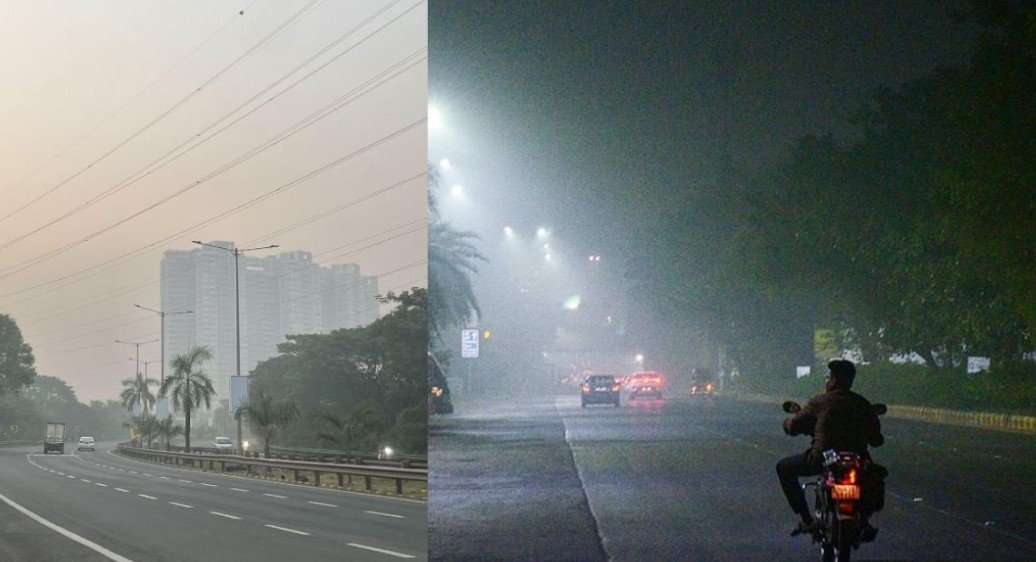
Mahape records the city’s highest AQI at 141, while environmentalists call for stricter action and improved pollution standards.
The Demand
Air pollution continues to be a concern in Navi Mumbai, with the Air Quality Index (AQI) remaining above 100 since October 16. According to the Central Pollution Control Board’s (CPCB) National Air Quality Data Management System, the city recorded an AQI of 121 at 2.05 pm on October 19. Mahape reported the highest AQI at 141, while the monitoring station in Sector 2E, Kalamboli, recorded the lowest at 103. Other locations also registered elevated readings, including CBD Belapur (133), Koparipada-Vashi (131), Tondare-Taloja (125), Sanpada (115) and Nerul (109). PM10 and PM2.5 were among the prominent pollutants recorded in CBD Belapur.
Environmental activist BN Kumar criticised the administration’s response, stating that rising pollution levels reflected inadequate regulation of construction activities, vehicle emissions and industrial pollution. He urged residents to demand accountability and concrete measures to protect public health and the environment. Activists have also questioned the difference between India’s AQI classification and that of the United States. Under India’s system, readings between 101 and 200 are classified as ‘Moderately Polluted’. In the US, readings of 101–150 fall under ‘Unhealthy for Sensitive Groups’.
Jyoti Nadkarni, a Kharghar-based resident and environmental activist, called for India to upgrade its pollution standards and give environmental protection greater priority. The elevated AQI levels raise concerns for children, senior citizens and people with respiratory or cardiovascular conditions, who are particularly vulnerable to the effects of air pollution.

Activists question the legality of installations, citing possible tender violations, road safety risks and lack of civic permissions.
The Hoardings
Giant digital hoardings installed at prominent junctions along Palm Beach Road have sparked controversy over alleged tender violations, road safety and civic accountability. Environmental activists and advertising agencies have questioned whether the installations comply with the Navi Mumbai Municipal Corporation’s (NMMC) advertising contract.
The five-year contract awarded to M/s Ronak Advertising Agency reportedly covers 36 existing hoardings at 30 public and community toilet locations across the city. The agency is said to pay the civic body approximately Rs 2.25 crore annually. However, allegations have emerged that large digital displays have been installed at prominent Palm Beach Road junctions beyond the locations specified in the contract. Activists have demanded an investigation into the permissions granted and compliance with the tender conditions. Local MLA Manda Mhatre had earlier objected to the installation of large hoardings near traffic signals and reportedly sought cancellation of the contract.
Activists have also warned that bright, illuminated displays featuring changing advertisements could distract motorists at busy junctions and increase road safety risks. Questions have additionally been raised about structural safety inspections and compliance with applicable regulations. Environmental activist Bhaskar Machhare said a delegation of activists and advertising contractors had met the municipal commissioner to raise concerns over the allegedly unauthorised installations.
According to Machhare, the commissioner clarified that he had not granted permission for the hoardings and directed the concerned officials to take immediate action. The controversy has intensified demands for a thorough inquiry into the approval process and the role of officials responsible for regulating outdoor advertisements. The civic body’s response and any action against the disputed structures are now being closely watched.

FDA Suspends Three Dairy Units in Taloja Over Suspected Milk Adulteration

Navi Mumbai AQI Remains Above 100, Activists Demand Stronger Pollution Control

Giant Digital Hoardings on Palm Beach Road Raise Tender Violation Concerns

Nidhi Razdan, fake Harvard professorship, and here is the explanation through her blog.

As the arrangement with Prashant Kishor falls through Rahul Gandhi has gone overseas again and is uncontactable

BSNL reveals all new 4G plans starting at ₹16

-
 Fact Check6 years ago
Nidhi Razdan, fake Harvard professorship, and here is the explanation through her blog.
-
 India4 years ago
As the arrangement with Prashant Kishor falls through Rahul Gandhi has gone overseas again and is uncontactable
-
 Technology5 years ago
BSNL reveals all new 4G plans starting at ₹16
-

 Latest News5 years ago
Government has spent ₹9,725 crores on Covid-19 vaccination drive so far
-

 Latest News5 years ago
Tata wins Air India with ₹18,000 crore bid
-

 Latest News5 years ago
Jharkhand government cuts Petrol price by massive ₹25 a litre but with a catch
-

 Latest News5 years ago
Raj Kundra Gave ₹25 Lakh Bribe to Mumbai Crime Branch to Avoid Arrest
-

 Navi Mumbai5 years ago
Navi Mumbai civic body raids and tests morning walkers, many found COVID positive