
India
UPI for Feature Phones from RBI


On Tuesday, the Reserve Bank of India (RBI) announced UPI123Pay, a new digital payment option for feature phones based on the Unified Payments Interface (UPI). The UPI system has so far been restricted to smartphones with internet access. India’s mobile phone population is estimated to be at 180 million. 78 crore of these people have smartphones, while the remaining 78 crores have feature phones. Due to the phone they use, tens of thousands of users have been unable to do UPI transactions. The central bank of India introduced this new payment mechanism to incorporate all such users and bring them into the mainstream of digital payments.
“UPI123Pay would enable NPCI to accomplish its goal of a billion or more daily UPI transactions,” said Biswamohan Mahapatra, head of the National Payments Corporation of India (NPCI), the country’s umbrella organization for retail digital payments.
Working of UPI on Feature Phones?
Users will be able to conduct UPI transactions on feature phones using UPI 123Pay. Except for the scan and pay UPI option available for smartphones, consumers will be able to use all other functionalities. Transactions with the new digital payment mode don’t require an internet connection. To utilize the UPI 123Pay service, people must link their bank accounts to their feature phones. People with feature phones can now use the UPI 123Pay option for a variety of payments, from person to person to the merchant. UPI 123Pay would employ Hindi and English as their primary languages at first.
“We feel that the novel functions available on feature phones would give UPI a boost in many geographies across the country, transforming the way payments are perceived,” Mahapatra said.
UPI: India’s Most Popular Payment Method
In recent years, UPI has become one of India’s most popular payment methods. UPI is the country’s single largest retail payment system in terms of transaction volume.
“A substantial portion of digitalization is limited to people with smartphones, notwithstanding our tremendous growth in digital payments.” “About 40 crore feature phone users had limited access to digital payments,” said T Rabi Sankar, deputy governor of the Reserve Bank of India. He stated that the goal is to attract a significant number of feature phone users into the UPI payment system.
“To further popularise the usage of digital payments, a framework for retail offline payments across the country has been proposed.” This announcement has its roots in a series of successful pilot studies. The results of these experiments strongly suggest that there is more leeway for digital payment-related solutions, particularly in rural areas. According to Nitin Mathur, CEO of Tavaga Advisory Services, “the RBI is enthusiastic about expanding the ease of doing business in India as well as more innovative fintech prospects to capitalize on” as a result of this development.


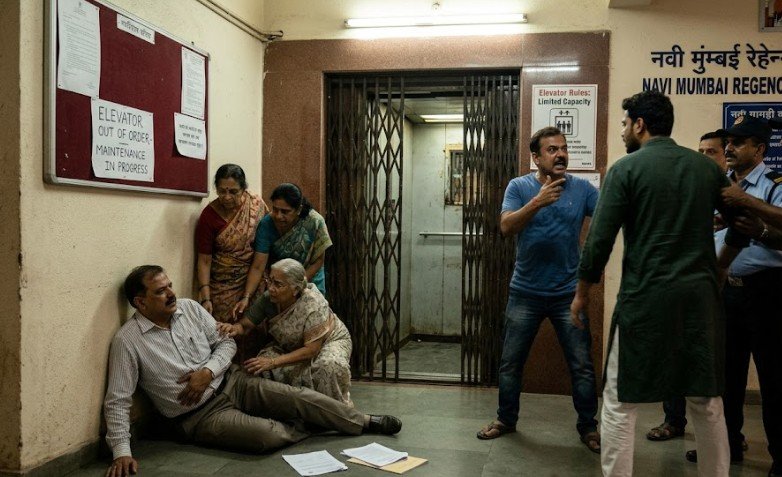
Police arrest two men after an argument over a lift-related issue at a housing society turns violent.
The Case
The incident took place at Ashtavinayak Society in Adai village, Panvel taluka, around 11 pm on Tuesday. According to police, the dispute began over the society’s elevator repeatedly malfunctioning.
The victim, Vaibhav Ramchandra Patil, 43, was called to the ground floor by one of the accused, Vishwas Bhaskar Jadhav, 31, to discuss the lift problem. Jadhav was accompanied by Hrishikesh Suresh Satpute, 36. During the argument, Satpute allegedly attacked Patil with a knife, injuring his neck, chest, abdomen, back and thigh. Patil’s wife reportedly tried to intervene, but the accused allegedly pushed her away.
The entire incident was captured on CCTV cameras installed near the ground-floor elevator. Patil was admitted to Veer Hospital in New Panvel for treatment. Khandeshwar police arrested both accused and registered a case of attempted murder and other offences against them.
A Panvel court remanded the two men in police custody until October 9 for further investigation. The incident highlights how a dispute over a common housing society facility allegedly escalated into a violent attack.
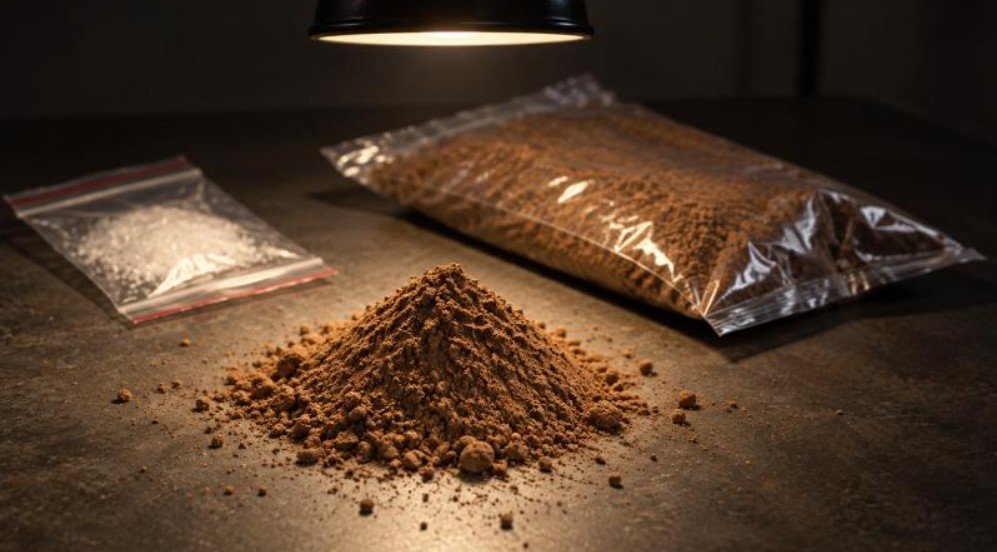
Police seize a large quantity of suspected narcotics during an operation in Navi Mumbai and launch further investigations into the case.
The Drugs
Navi Mumbai police arrested a Nigerian national, identified as Anyi Ikechukwu Darlington, from his rented apartment in Rohinjan village, Taloja, on Thursday night.
According to police, the Anti-Narcotics Cell carried out the raid after receiving specific information about drug-related activities. During the search, officers recovered 2.497 kg of mephedrone and 566 grams of cocaine, with an estimated market value of Rs 3.57 crore.
Police said the accused had previously been arrested in a separate narcotics case in Mumbai in 2019. He was released on bail in 2025. A case has been registered against him under the Narcotic Drugs and Psychotropic Substances (NDPS) Act at Taloja police station.
Investigators are now trying to trace the source of the seized drugs and determine whether other people were involved in the alleged drug distribution network. The investigation is ongoing.
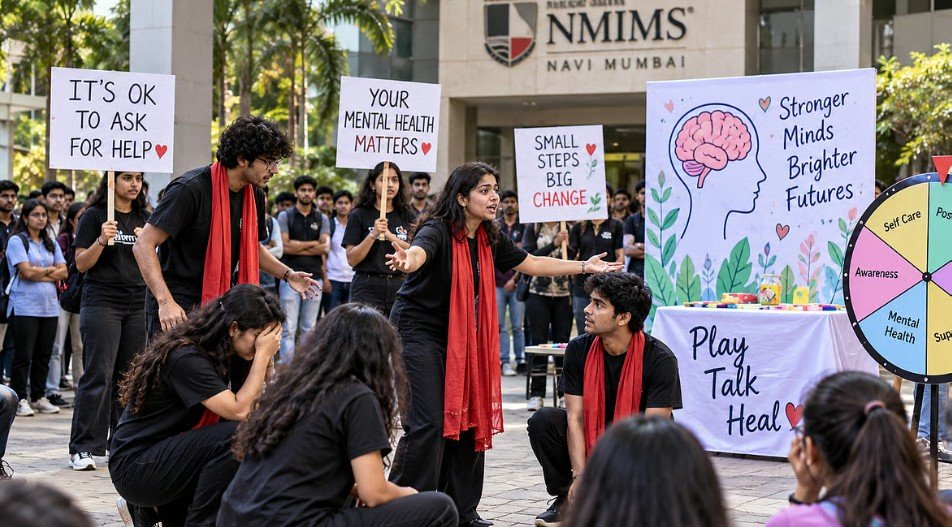
Students use interactive games and creative performances to encourage open conversations about mental health and emotional well-being.
The Awareness
Students of NMIMS Navi Mumbai have taken an innovative approach to spreading mental health awareness through street theatre and interactive activities. The initiative aims to help people understand the importance of emotional well-being and encourage them to speak openly about mental health concerns.
The two-day Mental Health Awareness Week featured discussions on women’s physical and mental health, a student-led street play highlighting women’s safety and dignity, and activities designed to help participants understand human behaviour. A panel of experts discussed how social expectations, family environments, reproductive health and childhood experiences can affect women’s emotional well-being. They also stressed the importance of discussing women’s health without stigma or judgement.
Students took part in interactive activities focusing on memory, attention, decision-making and social behaviour. They also prepared posters explaining different psychological disorders to make information about mental health easier to understand. The street play highlighted how social inequalities and expectations can limit women’s freedom and choices. The event concluded with a karaoke session, giving students an opportunity to relax and interact with one another.
The initiative aimed to make conversations about mental health more open, reduce stigma and encourage students to understand the importance of emotional well-being.

Housing Society Secretary Stabbed Over Elevator Dispute Near Navi Mumbai

Nigerian National Arrested in Navi Mumbai with Drugs Worth Rs 3.57 Crore

NMIMS Navi Mumbai Students Promote Mental Health Awareness Through Street Theatre

Nidhi Razdan, fake Harvard professorship, and here is the explanation through her blog.

As the arrangement with Prashant Kishor falls through Rahul Gandhi has gone overseas again and is uncontactable

BSNL reveals all new 4G plans starting at ₹16

-
 Fact Check6 years ago
Nidhi Razdan, fake Harvard professorship, and here is the explanation through her blog.
-
 India4 years ago
As the arrangement with Prashant Kishor falls through Rahul Gandhi has gone overseas again and is uncontactable
-
 Technology5 years ago
BSNL reveals all new 4G plans starting at ₹16
-

 Latest News5 years ago
Government has spent ₹9,725 crores on Covid-19 vaccination drive so far
-

 Latest News5 years ago
Tata wins Air India with ₹18,000 crore bid
-

 Latest News5 years ago
Jharkhand government cuts Petrol price by massive ₹25 a litre but with a catch
-

 Latest News5 years ago
Raj Kundra Gave ₹25 Lakh Bribe to Mumbai Crime Branch to Avoid Arrest
-

 Navi Mumbai5 years ago
Navi Mumbai civic body raids and tests morning walkers, many found COVID positive