
Latest News
Sujit Kumar, a BJD MP and the convener of the APIPFI, condemns China for objecting to Indian MPs taking part in the Tibetan Advocacy Campaign

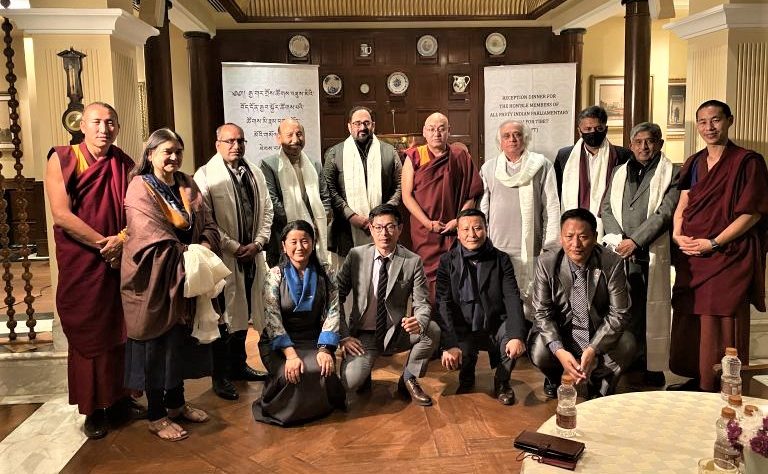
Six Indian lawmakers, led by Union Minister of State Rajeev Chandrasekhar, attended a dinner event organised by the Tibetan Parliament-in-Exile, infuriating expansionist China, which illegally seized Tibet.
Apart from Chandrasekhar, BJP’s Maneka Gandhi and KC Ramamurthy, Congress MPs Jairam Ramesh and Manish Tewari, and BJD’s Sujeet Kumar all attended a similar event on December 22 at the Imperial Hotel in Delhi. The occasion was attended by Khenpo Sonam Tenphel, the Speaker of the Tibetan Parliament in Exile.
MPs attended the Tibetan Outreach Campaign programme as part of the All-Party Indian Parliamentary Forum for Tibet, according to the Tibetan Parliament’s website (APIPFT). The show lasted for more than a week. Other members of Parliament who were at the event included minister Ramdas Athawale, Janardan Singh Sigriwal, Swapan Dasgupta, Chandeshwar Prasad, Suresh Kumar Kashyap, Sabtagiri Ulka, and Rani Pratibha Singh.
Ministers and MPs engaging in the official Tibetan programme is significant divergence from the Centre on Tibet-related Program’s February 22, 2018 advice. In the guidance, the Centre advised senior leaders and government officials to avoid attending gatherings hosted by Tibetan authorities due to the deterioration of bilateral relations.
The Political Counsellor of the Chinese Embassy in India, Zhou Yongsheng, sent protest letters to MPs, requesting that they refrain from supporting the ‘Tibetan independence forces.’ China is infamous for breaking diplomatic conventions. However. The BJD MP and convener of the All-Party Indian Parliamentary Forum for Tibet (APIPFT) snubbed China for daring to write to MPs after China sent a letter of protest to them.

MPs refuse to write letters to the Chinese Embassy in Beijing.
Sujeet Kumar, a BJD MP who has been chosen as the new head of APIPFI, has slammed the Chinese Embassy for sending an undiplomatic letter to MPs directly.
B Sujeet Kumar questioned how the Chinese Embassy’s Political Counsellor could write a letter to members of the Indian Parliament, which represents the world’s greatest democracy. “How dare you write letters to Indian legislators?” If anything, you can use official means to express your dissatisfaction. Kumar believes the MEA (Ministry of External Affairs) to take a stand.
Because of their shared history, civilization, Buddhism, and trade, he added, the Parliamentary forum’s stated goal was to develop a relationship between the government-in-exile and the people of India. The primary concept, he explained, was to build on such connections. He revealed that the Chinese Embassy sent him four or five letters, to which he responded appropriately. He also stated that Tibet is not considered to be a part of China.
The Chinese Political Counsellor also sent a letter to Congress leader Jairam Ramesh. He claimed he came to the event because of his strong affection for the Lord Buddha, deep respect for the Dalai Lama, and Tibetan sources’ contribution to the rediscovery of India’s Buddhist legacy.
On the other hand, Union minister Chandrasekhar stated he was a part of the Indo-Tibetan Parliamentary Forum, which is chaired by BJP veteran Shanta Kumar. He was invited to the occasion and ate dinner there.
In 1970, APIPFT was formed.
APIFT was founded in 1970 by Mohomedali Currim Chagla to advocate for Tibet’s cause with the help of notable Indian parliamentarians. Madhu Limaye, George Fernandes, Rabi Ray, Atal Bihari Vajpayee, T.N. Chaturvedi, Mohan Singh, and Satyavrat Chaturvedi were among the veterans parliamentarians involved in this.
Tibetans have a second home in India.
The Dalai Lama arrived in India on March 17, 1959, after a failed revolt against the Communist government in Lhasa. In exile in Dharamshala, where he also lives, he established his administration. Around 140,000 Tibetans are presently living in exile, with over 100,000 of them in India. Tibet is home to around six million Tibetans.






Police report no violations, while residents raise concerns over loud dhol-tasha and firecrackers.
The Noise
The issue of noise pollution during this year’s Ganesh visarjan has sparked a debate in Navi Mumbai, with residents raising concerns even as the police said no mandal had crossed the prescribed noise limits.
According to the Navi Mumbai Police, sound levels were monitored during visarjan processions using sound-level meters. Officials said they did not find any Ganesh mandal violating the permitted limits and noted that several mandals had avoided using DJs following instructions from the authorities. However, some residents said the celebrations were still excessively loud in certain areas. They complained about the noise from dhol-tasha performances and firecrackers, saying it was particularly difficult for senior citizens, young children and people who were unwell.
A member of a city-based organisation claimed that dhol-tasha performances crossed 80 decibels at some locations. Residents have also sought greater transparency regarding the monitoring process. The police have not publicly released detailed information about the sound readings, such as where measurements were taken or the highest and lowest levels recorded. Such data could help address concerns and provide a clearer picture of the situation.
The issue has also drawn attention because of action taken in neighbouring Thane, where police reportedly registered 69 cases for noise-related violations and firecracker use during the immersion period. The debate highlights the challenge of balancing traditional celebrations with residents’ need for a peaceful environment, particularly during large public festivals.
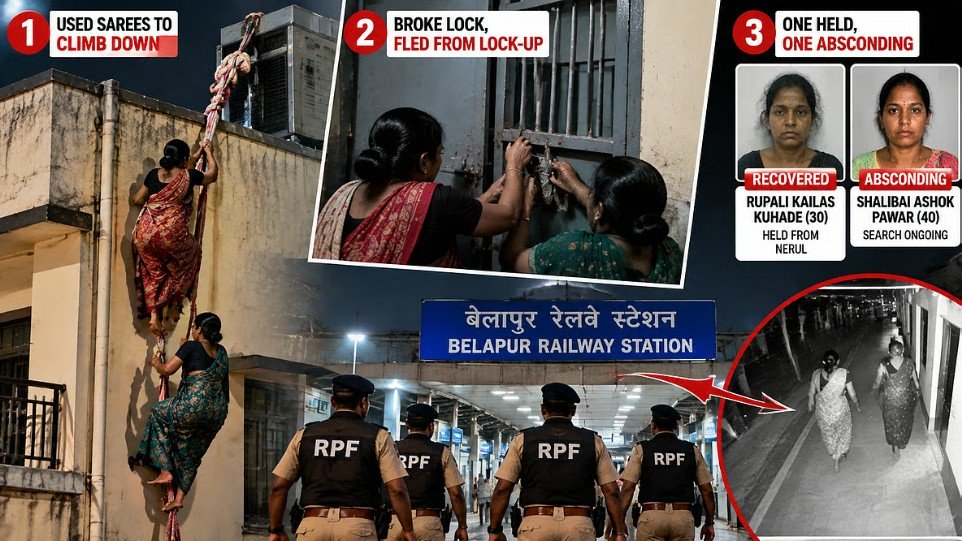
One woman arrested near Nerul, while police continue searching for the second accused.
The Theft
In a dramatic incident, two women accused of stealing railway material escaped from the RPF lock-up at Belapur railway station by allegedly using their sarees as a makeshift rope.
The women, identified as Rupali Kailas Kurhade, 30, and Shalibai Ashok Pawar, 40, had been arrested on September 26 in connection with the alleged theft of electric overhead wires from a railway godown at Juinagar.
According to officials, the women escaped at around 2:13 am on September 28. They allegedly broke the lock of the lock-up, reached the rear balcony and used their sarees to climb down from the building. The escape came to light when the woman constable posted at the lock-up returned and found the two accused missing. Officials subsequently checked CCTV footage and launched a search operation.
RPF teams managed to trace Rupali Kurhade near Nerul railway station at around 8:45 am, following which she was taken back into custody. However, Shalibai Pawar is still absconding. Railway police and RPF teams are continuing efforts to locate her and are examining CCTV footage and other available information.
A separate case has been registered at Panvel Railway Police Station in connection with the escape. The incident has also raised questions about security arrangements at the railway lock-up.
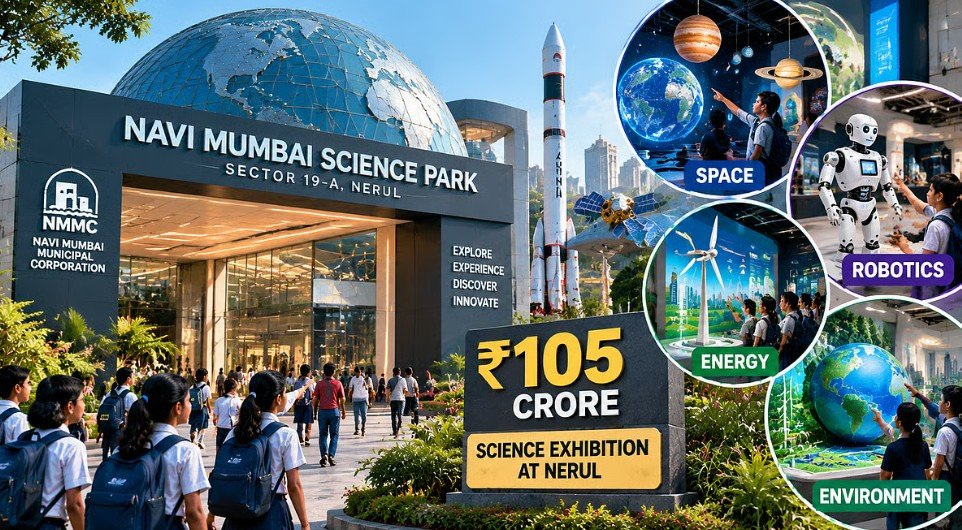
New facility aims to make science learning more engaging through technology and hands-on exhibits.
The Exhibition
Science learning could soon become more interactive for children and families in Navi Mumbai, with the Navi Mumbai Municipal Corporation (NMMC) planning a major exhibition at the Science Park in Nerul.
The civic body has proposed spending around Rs 105 crore on the project, which will introduce technology-based and hands-on exhibits to help visitors understand scientific concepts in a more interesting way. The proposed exhibition will cover topics such as human biology, DNA, cells, eyesight, hearing, ageing and the human body. Instead of simply reading information, visitors will be able to learn through interactive models, digital screens and practical activities.
Among the planned attractions are a DNA puzzle, cell laboratory, digital microscope, body mirror, BMI station, giant ear, hearing test and adjustable eye model. These exhibits are expected to give students an opportunity to explore scientific concepts by actually interacting with them. The project is part of NMMC’s efforts to develop the Nerul Science Park into a modern educational and recreational destination. The aim is to encourage curiosity and make learning more enjoyable, particularly for school and college students.
NMMC had issued a tender for interior work, science-themed exhibits and related services. The estimated tender value was around Rs 104.36 crore. If implemented, the project could give Navi Mumbai residents a new space where education and technology come together, allowing children to learn science through experience rather than textbooks alone.

Ganesh Visarjan Noise Sparks Debate in Navi Mumbai

Two Women Accused in Railway Theft Escape RPF Lock-Up Using Sarees

NMMC Plans ₹105 Crore Interactive Science Exhibition in Nerul

Nidhi Razdan, fake Harvard professorship, and here is the explanation through her blog.

As the arrangement with Prashant Kishor falls through Rahul Gandhi has gone overseas again and is uncontactable

BSNL reveals all new 4G plans starting at ₹16

-
 Fact Check6 years ago
Nidhi Razdan, fake Harvard professorship, and here is the explanation through her blog.
-
 India4 years ago
As the arrangement with Prashant Kishor falls through Rahul Gandhi has gone overseas again and is uncontactable
-
 Technology5 years ago
BSNL reveals all new 4G plans starting at ₹16
-

 Latest News5 years ago
Government has spent ₹9,725 crores on Covid-19 vaccination drive so far
-

 Latest News5 years ago
Tata wins Air India with ₹18,000 crore bid
-

 Latest News5 years ago
Jharkhand government cuts Petrol price by massive ₹25 a litre but with a catch
-

 Latest News5 years ago
Raj Kundra Gave ₹25 Lakh Bribe to Mumbai Crime Branch to Avoid Arrest
-

 Navi Mumbai5 years ago
Navi Mumbai civic body raids and tests morning walkers, many found COVID positive