
Latest News
Environmentalists predict that Navi Mumbai’s IT hub won’t be environmentally friendly

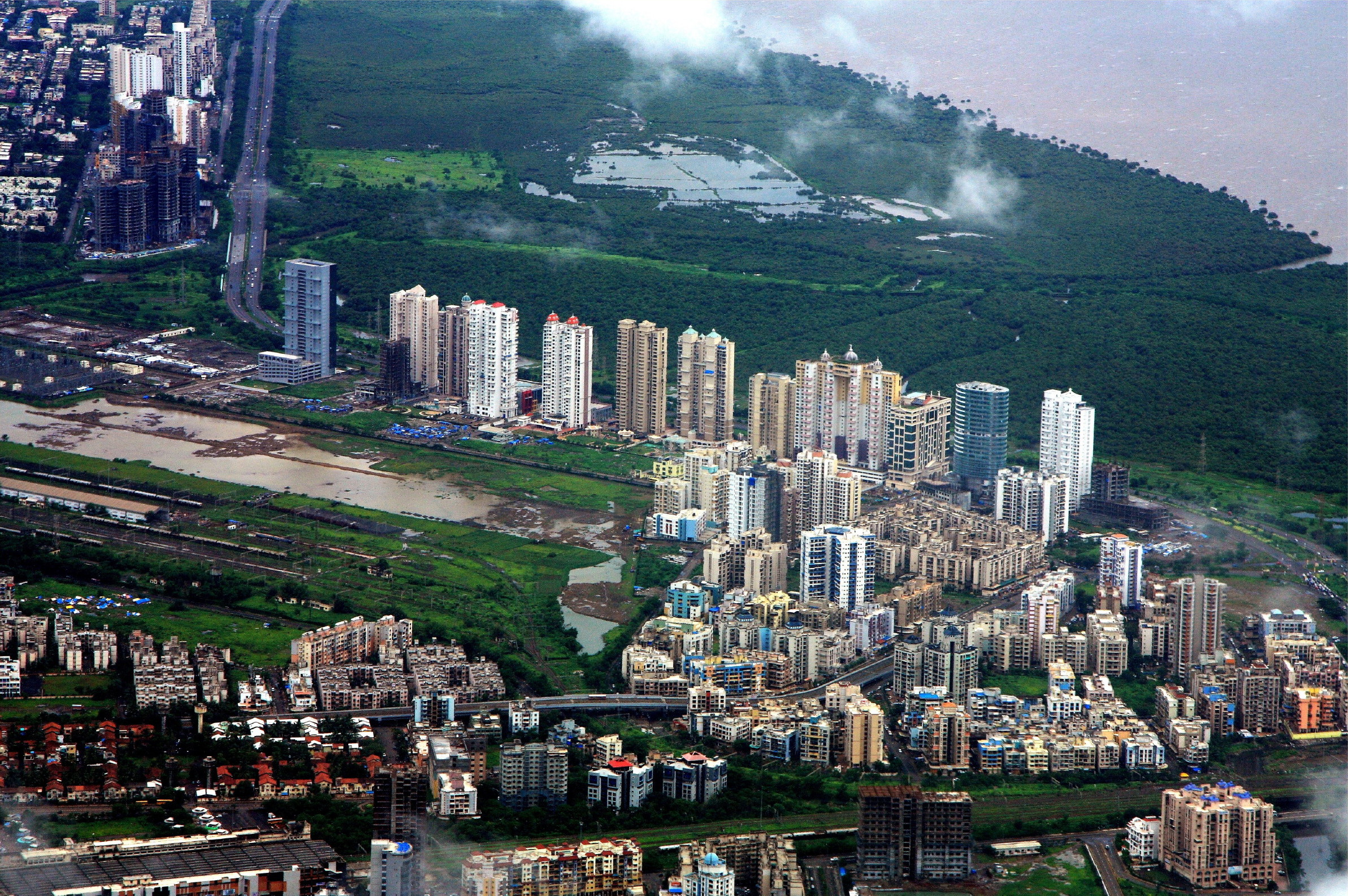
According to local environmentalists, the planned IT project in the Navi Mumbai Special Economic Zone (NMSEZ) will be disastrous since it will be built on mangroves and wetlands in Uran. The state government authorised the creation of an Integrated Industrial Authority with 85% commercial and 15% residential usage in the NMSEZ earlier this year.
The chief minister and the Union Ministry of Environment, Forest and Climate Change (MOEFCC) have received complaints from NatConnect Foundation about the allocation of large areas of mangrove zones and wetlands to NMSEZ by CIDCO. In addition, it was claimed that the degradation of mangroves and wetlands had gone uncontrolled.
According to NatConnect, not even the Bombay high court’s directives to repair the wetlands and mangroves have been followed. Given this, it claimed that the future project will undoubtedly result in catastrophes.
“The careless dumping on mangroves and wetlands is already creating floods in communities and rice fields,” said Nandakumar Pawar, director of Sagarshakti. “This is because the development has impeded the free passage of tidal water and raised land levels for the Dronagiri node.”
“Project proponents could label us doomsayers, but nature has already started to fight back with roads built on mangroves and wetlands growing large gaps and numerous towns struggling from floods,” he continued. The state approved the development of IT-related projects in the zone on February 17.
According to the GR, in addition to a medical school, a hospital, and related infrastructure, the integrated industrial area will also have an industry-academic partnership to promote training and skill development programmes through skill, development centres, research and development centres, training centres, digital centres, information, technology centres, training centres for art, performance, and sports, etc. According to green organisations, all of these will be built on mangroves and wetlands that make up the NMSEZ, and they “won’t be safe.”
“The 289-hectare intertidal Panje wetland, which is also meant to be a holding pond as a flood protection technique, is one of the key locations under dispute. The holding pond will vanish as a result of the holding pond area being designated by CIDCO as a part of the NMSEZ sector 16 to 28, according to Pawar, who also issued a flood warning for the region because there won’t be any land left over to absorb the extra water.
He said, “It is a question of basic knowledge that wetlands work as sponges to hold water and, regrettably, the urban planners lack it. “All mangroves are meant to have been given to the forest department for protection and conservation, according the high court’s September 2018 judgement, however there is no record of the tidal water plants under NMSEZ. “We have not heard anything more,” Pawar said of the chief minister’s request to the Mangrove Cell to examine these marine plants.












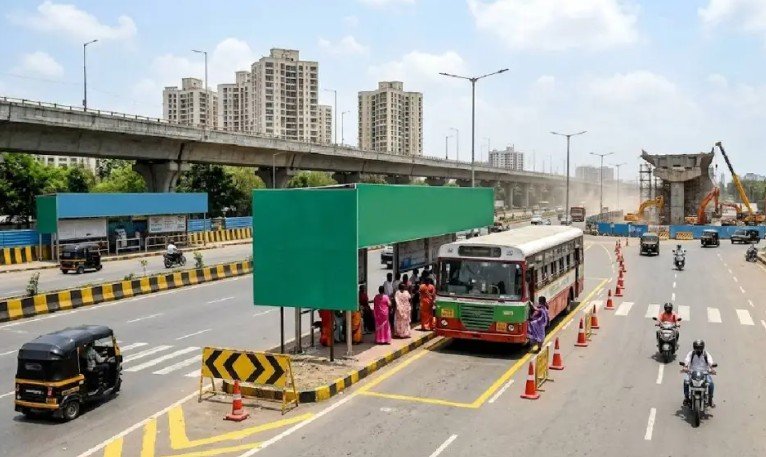
NMMT moves stops by 50 metres as authorities prepare traffic arrangements for demolition work.
The Bus Stop
Commuters travelling through Nerul and Turbhe may soon see changes in traffic movement as authorities prepare to demolish the remaining sections of the Turbhe flyover. To minimise inconvenience to passengers, NMMT has shifted the bus stops at Nerul LP by around 50 metres in both directions.
The bus stop for passengers travelling towards Panvel has been moved about 50 metres ahead, while the stop on the Vashi-bound side has also been relocated by a similar distance. New poles have been installed at the revised locations. Drivers and conductors from NMMT’s Turbhe, Asudgaon and Ghansoli depots have been instructed to use the new stops for passenger pick-ups and drop-offs.
The changes come as officials prepare for the demolition of the remaining two sections of the Turbhe flyover. One of the three sections is already undergoing work, while the demolition of the other two could affect traffic between Thane and Vashi. Traffic officials and the Public Works Department are working on an alternative traffic plan, including possible diversions through the Nerul LP underpass. However, the final diversion route and demolition schedule have not yet been announced.
Officials said the remaining sections of the flyover need to be demolished due to structural deterioration. Permissions and other preparations are currently underway.
For regular commuters, the temporary bus-stop shift is expected to be an important change to note as authorities work on the larger traffic management plan.
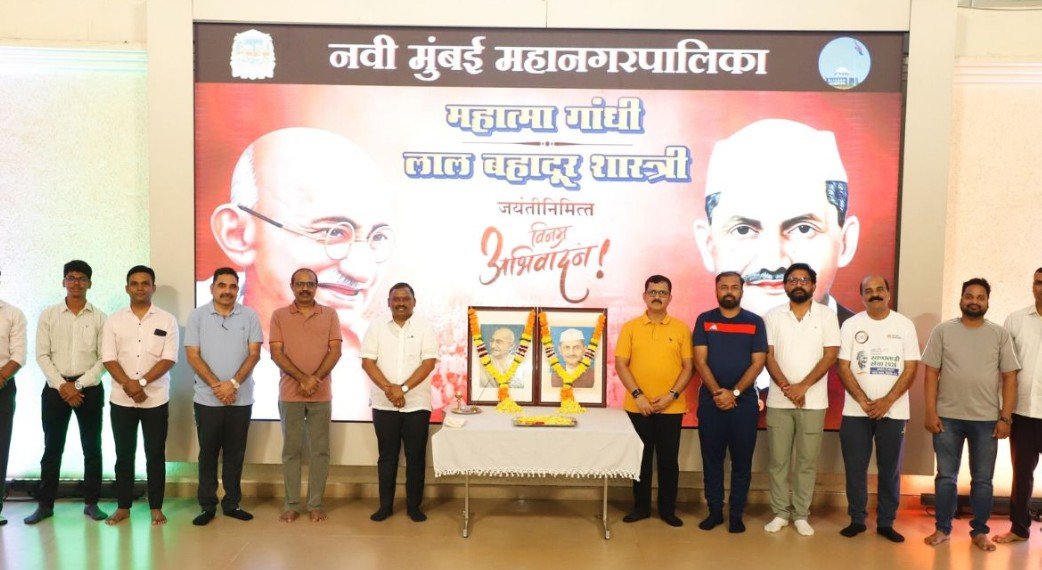
Civic officials remember the contributions of Mahatma Gandhi and Lal Bahadur Shastri at Belapur headquarters.
The Tribute
The Navi Mumbai Municipal Corporation (NMMC) paid tribute to Mahatma Gandhi and former Prime Minister Lal Bahadur Shastri on their birth anniversaries on October 2. A commemorative programme was held at the NMMC headquarters in Belapur, where NMMC Deputy Mayor Dashrath Bhagat offered floral tributes to the portraits of both national leaders at the civic headquarters’ amphitheatre.
Senior NMMC officials were present during the programme, including Additional Municipal Commissioner Sunil Pawar, Chief Auditor Rajendra Gadekar, Deputy Commissioner of Property Tax Dr Amol Palve, Deputy Commissioner of Solid Waste Management Dr Ajay Gadde and Chief Sanitation Officer Rajusingh Chavan.
The occasion provided civic officials an opportunity to remember the lives and contributions of two prominent figures in India’s history. Mahatma Gandhi is widely remembered for his leadership in India’s freedom movement and his emphasis on truth, non-violence and cleanliness. Lal Bahadur Shastri, India’s second Prime Minister, is remembered for his simple lifestyle, leadership and the slogan “Jai Jawan, Jai Kisan.”
The tribute programme also highlighted the continued relevance of their values in public life. For a civic body like NMMC, Gandhi’s emphasis on cleanliness and public responsibility remains particularly significant. Officials and staff gathered at the headquarters to mark the occasion and pay their respects to the two leaders. The programme concluded with floral tributes in their memory.

NMMC begins installing fitness equipment at the scenic CIDCO Nursery area following residents’ demand.
The Gym
Residents of CBD Belapur’s Sector 9 will soon have a new outdoor fitness facility close to their regular morning-walk route. The Navi Mumbai Municipal Corporation (NMMC) has started installing open gym equipment at the CIDCO Nursery hill area following a proposal raised by BJP corporator and Standing Committee member Swati Gurkhe.
The work was inaugurated in the presence of senior citizens, former corporator Ashok Gurkhe, Swati Gurkhe and several local residents. The CIDCO Nursery area is known for its greenery, trees and peaceful surroundings. Every morning, many residents visit the area for walking and exercise, making it a popular spot for health-conscious citizens. The new open gym is expected to give them an additional option to include basic strength and fitness exercises in their routine.
Swati Gurkhe said the proposal was made after residents requested better fitness facilities in the area. She said the civic administration has now started implementing the project and efforts will be made to provide good-quality equipment based on residents’ needs. She added that the facility could be expanded in the future if residents require additional equipment or improvements. Their suggestions will be considered while planning further work.
The initiative aims to make better use of the naturally green surroundings while encouraging residents, particularly senior citizens and regular walkers, to stay active and maintain a healthier lifestyle.

Nerul Bus Stops Shifted Ahead of Turbhe Flyover Demolition

NMMC Pays Tribute to Gandhi and Shastri on Birth Anniversaries

CBD Belapur’s Sector 9 to Get New Open Gym

Nidhi Razdan, fake Harvard professorship, and here is the explanation through her blog.

As the arrangement with Prashant Kishor falls through Rahul Gandhi has gone overseas again and is uncontactable

BSNL reveals all new 4G plans starting at ₹16

-
 Fact Check6 years ago
Nidhi Razdan, fake Harvard professorship, and here is the explanation through her blog.
-
 India4 years ago
As the arrangement with Prashant Kishor falls through Rahul Gandhi has gone overseas again and is uncontactable
-
 Technology5 years ago
BSNL reveals all new 4G plans starting at ₹16
-

 Latest News5 years ago
Government has spent ₹9,725 crores on Covid-19 vaccination drive so far
-

 Latest News5 years ago
Tata wins Air India with ₹18,000 crore bid
-

 Latest News5 years ago
Jharkhand government cuts Petrol price by massive ₹25 a litre but with a catch
-

 Latest News5 years ago
Raj Kundra Gave ₹25 Lakh Bribe to Mumbai Crime Branch to Avoid Arrest
-

 Navi Mumbai5 years ago
Navi Mumbai civic body raids and tests morning walkers, many found COVID positive