
Latest News
Vaccinating billions needs a robust global supply chain of raw materials for manufacturing vaccines

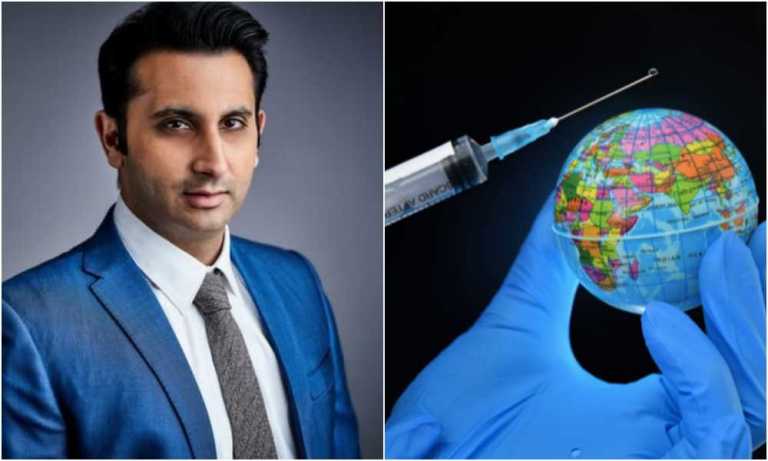
Recently, after a lot of criticism and NSA level discussions, the US administration has announced that they would allow the export of important raw materials required to produce the coronavirus vaccine in India. Amidst all the lobbying, politics, diplomacy, and ‘intellectual’ talks over raw material, it gets difficult to understand why India needs coronavirus vaccine raw materials from the United States.
What was so important that India cannot produce or import raw materials from other countries? Was it due to any patent issue or some IP issue, or it was just like the PPE kits that we used to import till the time there was no way to import them anymore? Making things clear, the situation in the case of coronavirus vaccines is completely different from the PPE kits.
Adar Poonawalla, the CEO of the Serum Institute of India has been expressing concerns over raw materials supply for weeks. The Serum Institute of India had lakhs of doses of Covishield ready beforehand the approvals came, it was an achievement that needed an investment of millions of dollars to speed up productions and a lot of uncertainty and risks. Unless the US embargo is lifted, the attempts of the Serum Institute of India to stockpile Novavax vaccine doses may be impacted, Mr. Poonawalla had said
According to World Trade Organization’s (WTO) report on “Developing And Delivering Covid-19 Vaccines Around The World”, vaccine manufacturing across the world is supported by complex upstream raw material and component value chains. Any typical vaccine manufacturing plant will use approx 9,000 different materials that it source from some 300 suppliers across approx 30 different countries.
The raw materials that Indian manufacturers require
- Bioreactor bags
- Filters
- Cell culture media
- Lipid Nanoparticles
- Microcarriers or Microcarrier beads
Though there are other companies in the world that can provide raw materials required for manufacturing vaccines, but due to the surge in demand, logistics, and regulatory issues at this time, it is difficult to find other suppliers. Change of suppliers is not feasible, especially at the time when India is facing an unexpected surge due to the second wave of the Coronavirus.




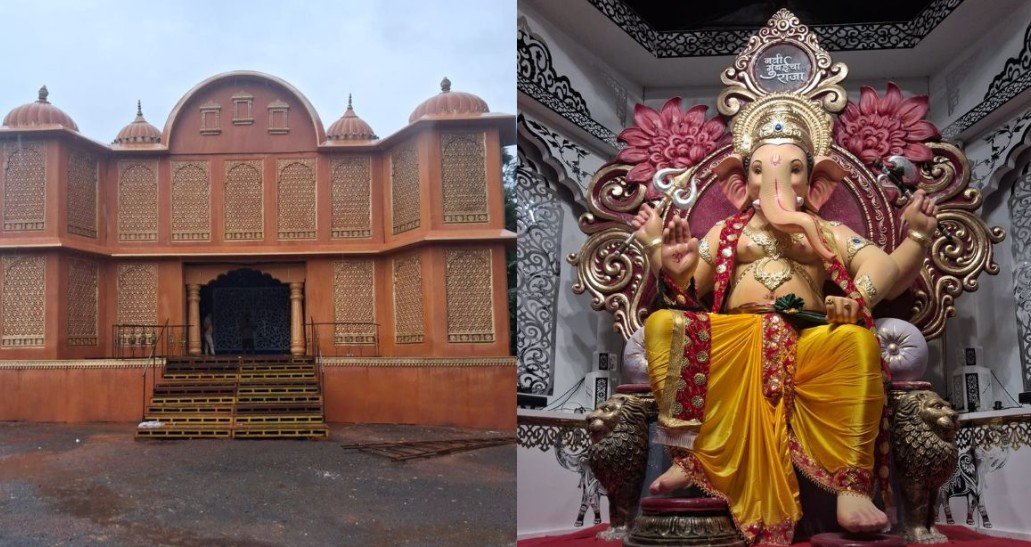
Ganesh mandal uses Ganeshotsav to spread awareness against addiction.
The Awareness
The Shivchhaya Mitra Mandal, popularly known as Navi Mumbaicha Raja, is using this year’s Ganeshotsav to promote a drug-free and healthy lifestyle. The mandal’s 56th Ganeshotsav is being organised at the CIDCO ground near ICL School in Sector 21, Turbhe. The celebrations began on September 14.
A major focus of this year’s festival is an anti-addiction campaign carrying the message “Say No to Drugs”. Through posters, banners and cut-outs, the mandal will create awareness about the harmful effects of alcohol, tobacco, gutkha, drugs, gambling and other addictive habits. The campaign promotes the message that a moment of pleasure can lead to lifelong problems, while staying away from addiction can lead to a happier life.
The festival will also include bhajans, spiritual programmes, blood donation and health camps, Annadan, Atharvashirsh recitation, Satyanarayan Mahapuja and felicitation of achievers. The mandal is also supporting tribal students from Wada and Mokhada in pursuing higher education after Classes 10 and 12.
Around 8 to 10 lakh devotees are expected to visit the pandal during the 12-day festival. A Satyanarayan Katha and Bhandara will be organised on September 24, with food arrangements for around 10,000 devotees.
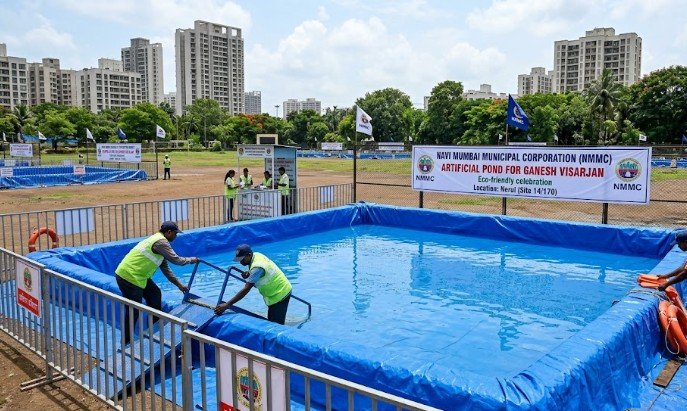
Civic body prepares 192 immersion sites to support a smooth and eco-friendly Ganeshotsav.
The Ponds
The Navi Mumbai Municipal Corporation (NMMC) has made arrangements for the smooth and eco-friendly celebration of Ganeshotsav 2026, which will be held from September 14 to 25. To reduce crowding and help prevent water pollution, the civic body has set up 170 artificial immersion ponds across the city, along with 22 natural immersion sites.
More than 140 Ganesh mandals have applied online for permission to install pandals. The NMMC has introduced a single-window system to make the approval process easier by bringing permissions from different departments together. Across all 192 immersion sites, arrangements have been made for volunteers, CCTV surveillance, electricity and generators. Medical teams will be deployed at 22 major immersion sites, while lifeguards and fire brigade personnel will also be available.
The civic body has arranged rafts at natural immersion sites and separate facilities for wet and dry nirmalya. Dedicated vehicles will collect floral waste and transport it to the processing facility in Turbhe. Road repairs and tree pruning along idol arrival and immersion routes have also been completed.
The NMMC has appealed to citizens to use artificial immersion ponds and celebrate Ganeshotsav in an eco-friendly manner, helping protect the city’s water bodies.
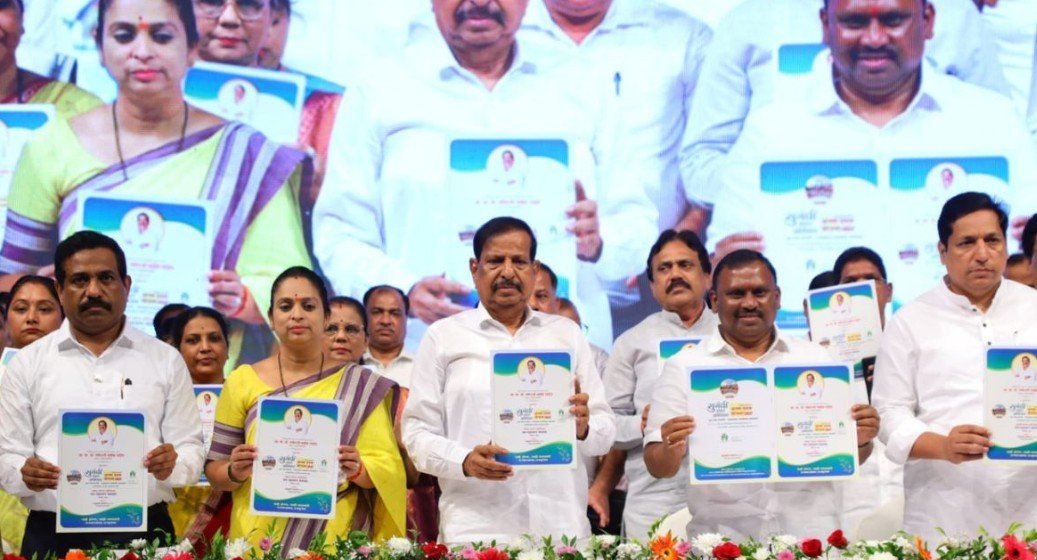
Initiative encourages residents, institutions and businesses to take responsibility for spaces around their premises.
The Launch
The Navi Mumbai Municipal Corporation (NMMC) has launched the Angan Adoption Scheme 2026 under the Sugandhi City Campaign, encouraging citizens to take responsibility for the cleanliness and upkeep of public spaces near their homes, shops and institutions.
The initiative was inaugurated by Maharashtra Forest Minister and Palghar Guardian Minister Ganesh Naik. During the programme, appreciation certificates were presented to individuals who had already come forward to adopt public spaces. A web portal for the campaign was also launched, along with a booklet explaining its objectives.
Mayor Sujata Patil, Deputy Mayor Dashrath Bhagat, former MP Sanjeev Naik, former MLA Sandeep Naik, House Leader Sagar Naik and other elected representatives and citizens attended the event. Addressing the gathering, Ganesh Naik said the initiative could help Navi Mumbai move towards becoming the cleanest city in the country. He stressed that cleanliness should not be limited to appearances, but should involve genuine public participation.
Deputy Mayor Dashrath Bhagat explained that the scheme focuses on three key elements—places, spaces and people. Residents, schools, colleges, hospitals, factories, shops and other institutions can adopt even small areas outside their premises, keep them clean and prevent garbage from being dumped there. The campaign promotes the message, “My courtyard, my responsibility,” and aims to turn cleanliness into a shared responsibility among Navi Mumbai’s citizens.

Navi Mumbaicha Raja Promotes Drug-Free Living

NMMC Sets Up 170 Artificial Immersion Ponds Across Navi Mumbai

Navi Mumbai Launches Angan Adoption Scheme to Keep Public Spaces Clean

Nidhi Razdan, fake Harvard professorship, and here is the explanation through her blog.

As the arrangement with Prashant Kishor falls through Rahul Gandhi has gone overseas again and is uncontactable

BSNL reveals all new 4G plans starting at ₹16

-
 Fact Check6 years ago
Nidhi Razdan, fake Harvard professorship, and here is the explanation through her blog.
-
 India4 years ago
As the arrangement with Prashant Kishor falls through Rahul Gandhi has gone overseas again and is uncontactable
-
 Technology5 years ago
BSNL reveals all new 4G plans starting at ₹16
-

 Latest News5 years ago
Government has spent ₹9,725 crores on Covid-19 vaccination drive so far
-

 Latest News5 years ago
Tata wins Air India with ₹18,000 crore bid
-

 Latest News5 years ago
Jharkhand government cuts Petrol price by massive ₹25 a litre but with a catch
-

 Latest News5 years ago
Raj Kundra Gave ₹25 Lakh Bribe to Mumbai Crime Branch to Avoid Arrest
-

 Navi Mumbai5 years ago
Navi Mumbai civic body raids and tests morning walkers, many found COVID positive