
Latest News
Ticket Prices Of Navi Mumbai Metro Reduces


The City and Industrial Development Corporation of Maharashtra (CIDCO) has announced a substantial drop in metro ticket costs for the Belapur-Pendhar corridor, which is a positive development for Metro riders in Navi Mumbai. With effect from September 7, the new pricing structure will result in fare reductions of up to 33%. The highest ticket has been restricted at Rs 30 and the lowest fare will now be Rs 10.
With longer travel distances for each cost slab, the revised fare scheme provides greater value for the money. A ticket will now cost Rs 10 for travels up to four kilometers, Rs 20 for travels between four and eight kilometers, and Rs 30 for travels beyond eight kilometers. The fee has been lowered from Rs 40 to Rs 30 from Belapur Terminal to Pendhar.
CIDCO has expanded the Navi Mumbai Metro service’s operating hours in addition to lowering fares. Metro services from Belapur and Pendhar stations will now start at six in the morning starting in April. The final metro train leaves Belapur at 11 p.m. and Pendhar at 10:30 p.m. This is a weekly extension that is applicable every day.
Along its 11.1-kilometer journey, the Belapur-Pendhar Line-1 of the Navi Mumbai Metro has 11 stops, with the train depot situated at Taloja Panchanand.
According to a statement made to the Hindustan Times by CIDCO’s vice chairman and managing director, Vijay Singhal, “the fare reduction and extended timings aim to make the metro service more accessible and convenient for both short- and long-distance commuters.”
Part of CIDCO’s Navi Mumbai Metro project, the Navi Mumbai Metro Corridor No. 1 connects Belapur to Pendhar and improves access to important locations including the CBD, Taloja MIDC, and CIDCO’s housing complexes in Kharghar. This line’s metro services started on November 17 of last year.
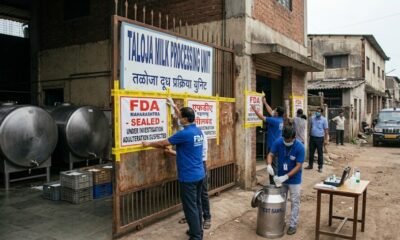




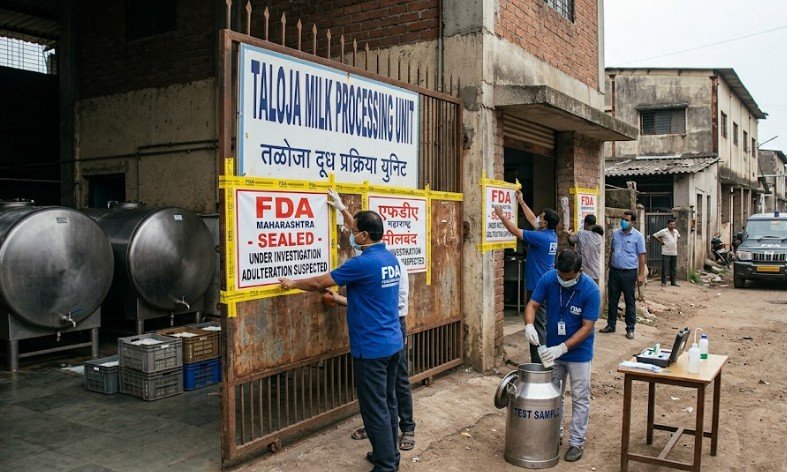
Authorities destroy 1,494 litres of suspected adulterated milk and register a criminal case against six people following inspections in Panvel.
The Adulteration
The Food and Drug Administration (FDA) has suspended the licences of three dairy units in the Taloja industrial area of Panvel following inspections that reportedly revealed violations of food safety and hygiene standards. The action was taken against Mateshwari Foods, Sawariya Milk and Milk Products, and Royal Foods, located in Balaji Industrial Park, Taloja.
During the inspection, FDA officials destroyed 1,494 litres of suspected adulterated milk and seized curd for further examination. Samples have been sent for laboratory testing, and further action will depend on the test results. A criminal case has also been registered against six people at Taloja police station. They are accused of involvement in the production, storage and sale of adulterated food products, raising concerns about the safety of dairy products supplied to consumers.
The FDA’s action highlights the importance of maintaining proper hygiene and following food safety regulations in dairy processing units. Authorities are investigating the matter, and further steps may be taken based on the findings. The incident has also raised concerns about the quality of milk and milk products available in the market, underlining the need for regular inspections to protect public health.
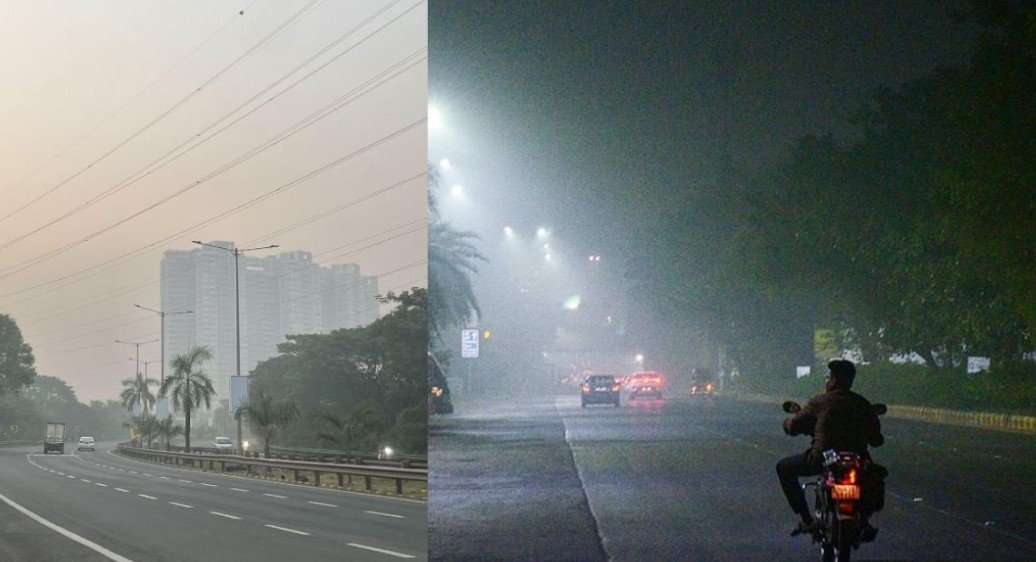
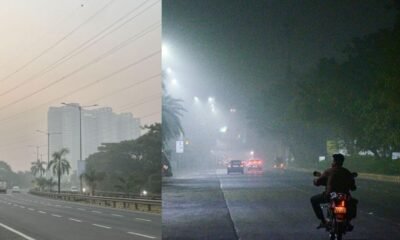
Mahape records the city’s highest AQI at 141, while environmentalists call for stricter action and improved pollution standards.
The Demand
Air pollution continues to be a concern in Navi Mumbai, with the Air Quality Index (AQI) remaining above 100 since October 16. According to the Central Pollution Control Board’s (CPCB) National Air Quality Data Management System, the city recorded an AQI of 121 at 2.05 pm on October 19. Mahape reported the highest AQI at 141, while the monitoring station in Sector 2E, Kalamboli, recorded the lowest at 103. Other locations also registered elevated readings, including CBD Belapur (133), Koparipada-Vashi (131), Tondare-Taloja (125), Sanpada (115) and Nerul (109). PM10 and PM2.5 were among the prominent pollutants recorded in CBD Belapur.
Environmental activist BN Kumar criticised the administration’s response, stating that rising pollution levels reflected inadequate regulation of construction activities, vehicle emissions and industrial pollution. He urged residents to demand accountability and concrete measures to protect public health and the environment. Activists have also questioned the difference between India’s AQI classification and that of the United States. Under India’s system, readings between 101 and 200 are classified as ‘Moderately Polluted’. In the US, readings of 101–150 fall under ‘Unhealthy for Sensitive Groups’.
Jyoti Nadkarni, a Kharghar-based resident and environmental activist, called for India to upgrade its pollution standards and give environmental protection greater priority. The elevated AQI levels raise concerns for children, senior citizens and people with respiratory or cardiovascular conditions, who are particularly vulnerable to the effects of air pollution.
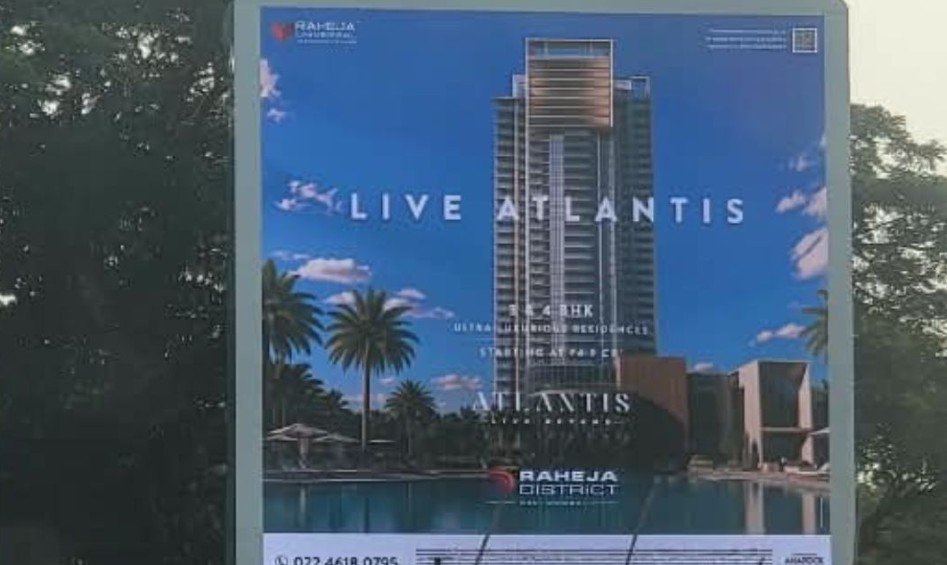
Activists question the legality of installations, citing possible tender violations, road safety risks and lack of civic permissions.
The Hoardings
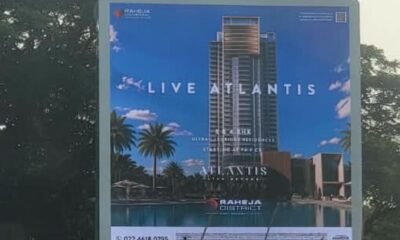
Giant digital hoardings installed at prominent junctions along Palm Beach Road have sparked controversy over alleged tender violations, road safety and civic accountability. Environmental activists and advertising agencies have questioned whether the installations comply with the Navi Mumbai Municipal Corporation’s (NMMC) advertising contract.
The five-year contract awarded to M/s Ronak Advertising Agency reportedly covers 36 existing hoardings at 30 public and community toilet locations across the city. The agency is said to pay the civic body approximately Rs 2.25 crore annually. However, allegations have emerged that large digital displays have been installed at prominent Palm Beach Road junctions beyond the locations specified in the contract. Activists have demanded an investigation into the permissions granted and compliance with the tender conditions. Local MLA Manda Mhatre had earlier objected to the installation of large hoardings near traffic signals and reportedly sought cancellation of the contract.
Activists have also warned that bright, illuminated displays featuring changing advertisements could distract motorists at busy junctions and increase road safety risks. Questions have additionally been raised about structural safety inspections and compliance with applicable regulations. Environmental activist Bhaskar Machhare said a delegation of activists and advertising contractors had met the municipal commissioner to raise concerns over the allegedly unauthorised installations.
According to Machhare, the commissioner clarified that he had not granted permission for the hoardings and directed the concerned officials to take immediate action. The controversy has intensified demands for a thorough inquiry into the approval process and the role of officials responsible for regulating outdoor advertisements. The civic body’s response and any action against the disputed structures are now being closely watched.

FDA Suspends Three Dairy Units in Taloja Over Suspected Milk Adulteration

Navi Mumbai AQI Remains Above 100, Activists Demand Stronger Pollution Control

Giant Digital Hoardings on Palm Beach Road Raise Tender Violation Concerns

Nidhi Razdan, fake Harvard professorship, and here is the explanation through her blog.

As the arrangement with Prashant Kishor falls through Rahul Gandhi has gone overseas again and is uncontactable

BSNL reveals all new 4G plans starting at ₹16

-
 Fact Check6 years ago
Nidhi Razdan, fake Harvard professorship, and here is the explanation through her blog.
-
 India4 years ago
As the arrangement with Prashant Kishor falls through Rahul Gandhi has gone overseas again and is uncontactable
-
 Technology5 years ago
BSNL reveals all new 4G plans starting at ₹16
-

 Latest News5 years ago
Government has spent ₹9,725 crores on Covid-19 vaccination drive so far
-

 Latest News5 years ago
Tata wins Air India with ₹18,000 crore bid
-

 Latest News5 years ago
Jharkhand government cuts Petrol price by massive ₹25 a litre but with a catch
-

 Latest News5 years ago
Raj Kundra Gave ₹25 Lakh Bribe to Mumbai Crime Branch to Avoid Arrest
-

 Navi Mumbai5 years ago
Navi Mumbai civic body raids and tests morning walkers, many found COVID positive