
Latest News
The Reserve Bank of India is expected to keep policy rates unchanged till April, according to a report.

The Monetary Policy Committee (MPC), the RBI’s rate-setting panel, will begin deliberations on Monday and announce policy decisions on Wednesday.
Almost all major central banks are raising interest rates to combat inflation. The Reserve Bank of Australia will keep rates steady, according to US brokerage Bank of America Securities.
After the Budget declared record borrowing intentions for the coming fiscal year, India’s benchmark 10-year bond yields are approaching 6.9%. The entire domestic and external climate, according to analysts at Edelweiss Brokerage, is unfavourable for the bond market.
Bank of America (BofA) analysts believe the MPC will keep rates steady when it releases its final policy review of the fiscal year on February 9. After the Budget disclosed a record borrowing plan, the market expected a 25 basis point reverse repo tightening.
India’s fiscal deficit is predicted to decline from 6.9% in FY22 (up 10 basis points from the revised projection) to 6.4 per cent in FY23. The enormous expenditure push at the expense of fiscal reduction is the budget’s main centrepiece for FY23.
Revenue spending, net of interest payments and subsidies, is forecast to increase by only 1% in FY23, while capital expenditures are expected to increase by 24%, implying more supply-side spending rather than a large demand boost, and hence no serious inflation pressure.
Given all of this, the RBI is expected to leave rates steady next Wednesday, even though the pandemic is still ongoing.
According to Bank of America Merrill Lynch, the first tightening step is anticipated to come in April or June. The RBI has started selling bonds after being a strong buyer in the first half, resulting in a large demand-supply mismatch and a surge in yields. It did so in the expectation that the government would enable local bonds to be included in international indices, but it has yet to do so.






Residents say unreliable CIDCO supply is forcing them to spend lakhs every month on water.
The Crisis
More than 350 families living in Akshar Estonia, Sector 47, Dronagiri, are struggling with an unreliable water supply and have been forced to depend on private tankers to meet their daily needs.
Residents claim that the CIDCO water supply, provided on alternate days, is insufficient and often comes with low pressure. As a result, the society has reportedly been spending around Rs 5 lakh every month on tanker water. Residents estimate that the expenditure has reached nearly Rs 1.5 crore over the past three years.
According to residents, the low pressure often prevents their underground water tanks from filling adequately. Technical issues in the main pipeline receiving water from the Hetawane dam, along with frequent supply interruptions, have further added to their difficulties. K.N. Bhat, president of the housing society, said residents have repeatedly approached CIDCO seeking a permanent solution, but the problem continues. He said the society is now considering legal action if the water shortage is not resolved.
The crisis has made everyday household activities difficult for families, while some residents have also raised concerns about the quality and safety of tanker water. Residents said that while Dronagiri is developing rapidly and more families are moving into the area, the water infrastructure has not kept pace with the growing population.
They have urged CIDCO to strengthen the water-supply network and provide a reliable long-term solution so that families are not forced to depend on expensive tankers for a basic necessity.

Environmental group flags construction debris, while residents complain of dust and inconvenience.
The Pond
Ongoing work on the walking track near Mini Seashore in Vashi’s Sector 9A has raised concerns over the condition of a nearby holding pond. Environmentalists and local residents have alleged that construction debris is being dumped near the pond, adding to the pressure on an already troubled water body.
The pond has reportedly been facing issues such as algae growth, polluted water and foul odour. Earlier incidents of fish deaths had also raised concerns about the health of the pond’s ecosystem. Environmental organisation NatConnect Foundation has urged the Navi Mumbai Municipal Corporation (NMMC) to take immediate action and ensure that construction waste is disposed of properly. The organisation also stressed the need to make workers aware of the environmental impact of dumping debris near water bodies.
NMMC officials have assured that the matter will be inspected. Vashi ward officer Sukhdev Yedve said an engineer would visit the site and appropriate instructions would be given to the contractor regarding the disposal of construction material. Meanwhile, regular walkers have complained that the ongoing work is making their daily routine difficult. Excavation and removal of paver blocks have reportedly created dust, making walking uncomfortable for residents.
Residents said development work is welcome, but it should not come at the cost of the pond or the surrounding environment. They urged the civic authorities to complete the project carefully while protecting the water body and keeping the walking area safe and clean.
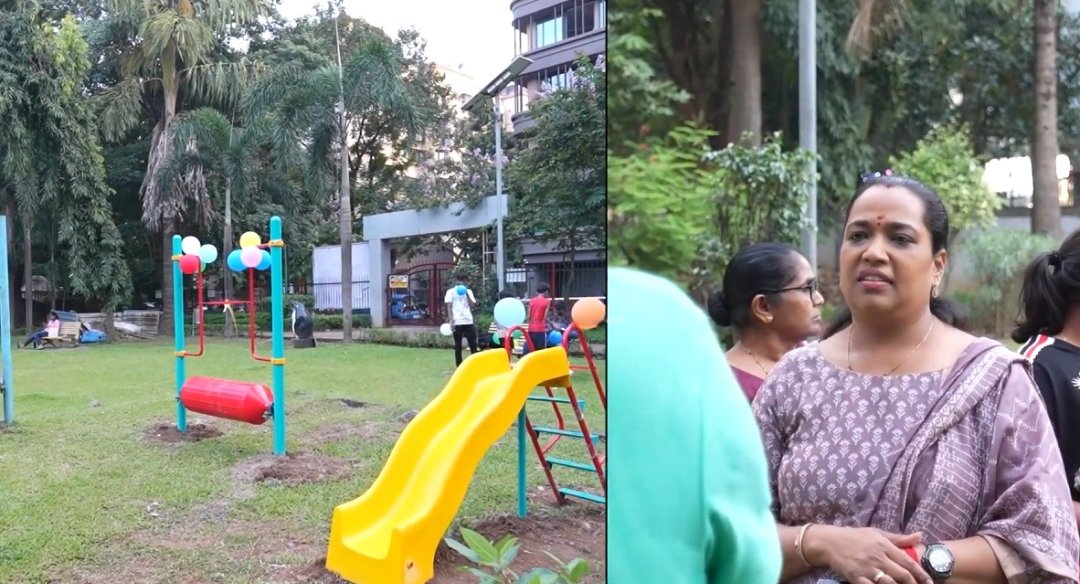
Sapna Gawde facilitates replacement of old and unsafe equipment at Dr Babasaheb Ambedkar Garden.
The Installation
Children in Seawoods Sector 42 now have a safer and more enjoyable space to play, with new playground equipment installed at Dr Babasaheb Ambedkar Garden in Nerul Ward No. 24. The old play equipment had been in poor condition for several years and had become unsafe for children. Residents had repeatedly raised concerns and requested that the damaged equipment be replaced.
Taking up the issue, local BJP corporator Advocate Sapna Gawde followed up with the Navi Mumbai Municipal Corporation (NMMC) through repeated correspondence and helped secure approval for installing new equipment.
The new facilities were inaugurated as part of Gawde’s birthday celebrations. In a special gesture, children themselves were invited to inaugurate the equipment, followed by a distribution of chocolates. The initiative brought visible excitement among the children and was appreciated by local residents.
Members of the Seawoods Residents Welfare Association thanked Gawde for ensuring that the old equipment, which was beyond repair, was replaced rather than merely repaired. Residents said the new playground could encourage children to spend more time outdoors and reduce their dependence on mobile phones. They also appealed to parents and children to use the equipment responsibly and help maintain the garden.
Sapna Gawde said that fulfilling the trust placed in her by residents remains her priority. She added that she would continue working to address civic concerns and improve facilities in the ward. She said the happiness of the children made the initiative one of the most meaningful parts of her birthday celebration.

Dronagiri Water Crisis Leaves 350 Families Dependent on Tankers

Walking Track Work Raises Concern Over Vashi Pond

New Play Equipment Installed at Seawoods Garden for Children

Nidhi Razdan, fake Harvard professorship, and here is the explanation through her blog.

As the arrangement with Prashant Kishor falls through Rahul Gandhi has gone overseas again and is uncontactable

BSNL reveals all new 4G plans starting at ₹16

-
 Fact Check6 years ago
Nidhi Razdan, fake Harvard professorship, and here is the explanation through her blog.
-
 India4 years ago
As the arrangement with Prashant Kishor falls through Rahul Gandhi has gone overseas again and is uncontactable
-
 Technology5 years ago
BSNL reveals all new 4G plans starting at ₹16
-

 Latest News5 years ago
Government has spent ₹9,725 crores on Covid-19 vaccination drive so far
-

 Latest News5 years ago
Tata wins Air India with ₹18,000 crore bid
-

 Latest News5 years ago
Jharkhand government cuts Petrol price by massive ₹25 a litre but with a catch
-

 Latest News5 years ago
Raj Kundra Gave ₹25 Lakh Bribe to Mumbai Crime Branch to Avoid Arrest
-

 Navi Mumbai5 years ago
Navi Mumbai civic body raids and tests morning walkers, many found COVID positive