
Latest News
Several missing and over 30 dead in Raigad landslide

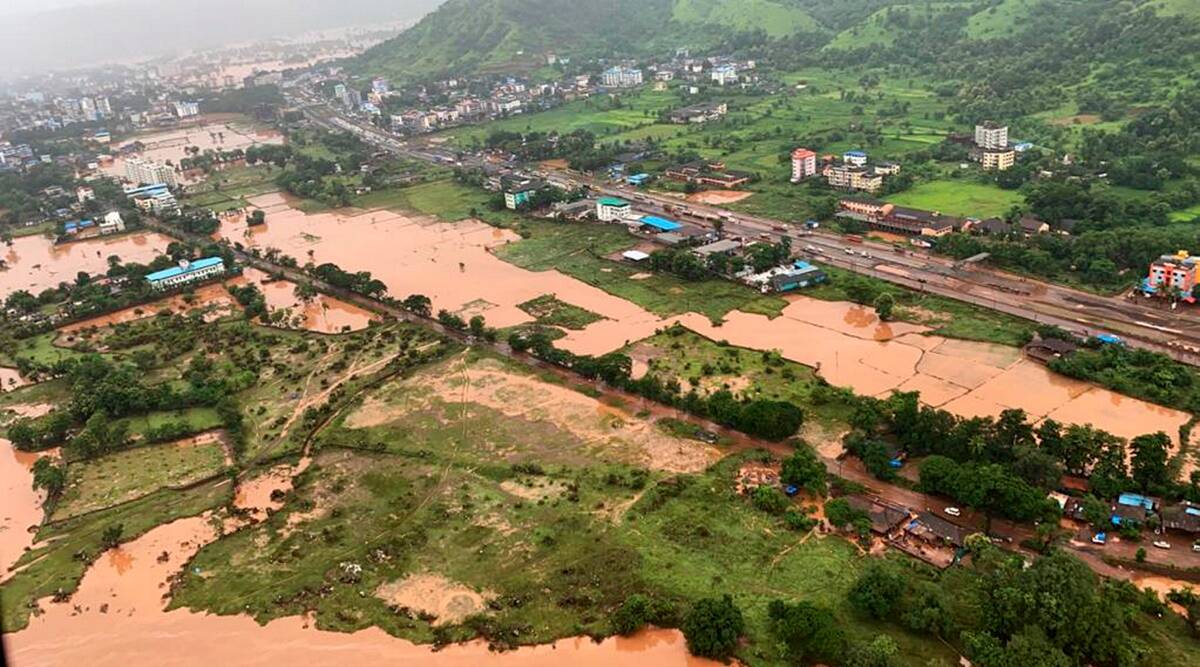
Amidst heavy rainfall across coastal and inland Maharashtra, at least 37 people were killed in separate incidents of landslides in the state.
As many as 32 died following a landslide in Taliye village in Mahad Taluka, Raigad on Thursday. Around 35 houses were buried under debris and several people were still feared to be missing or trapped under it. In another landslide, four people died in Poladpur, which is also a landslide-prone area.
Meanwhile, at least 12 villagers are believed to be trapped under debris due to a landslide in Mirgaon village in western Maharashtra’s Satara district. One body has been retrieved and efforts to locate others are underway.
Teams of NDRF, SDRF, Navy and local administration were rushed to the site on Thursday evening. However, rescue efforts were impeded by heavy showers, waterlogging, and connectivity issues. Local authorities are yet to ascertain the exact details of casualties.
“32 bodies have been recovered from the debris and the rescue operation is still on,” said Nidhi Chowdhury, Raigad District Collector. According to the district administration, there are around 110 villages in the district which are landslide-prone, and out of these 20 are particularly at risk.
Chief Minister Uddhav Thackeray said rescue operations were underway and that he had ordered the evacuation and relocation of people living in areas where there is a possibility of landslide.
INPUT: PTI









Duo allegedly demanded money for processing Mathadi worker registration at APMC market.
The Case
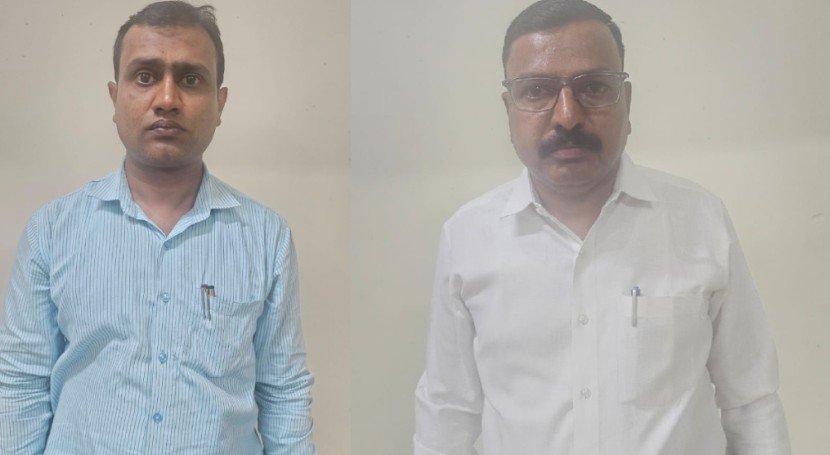
The Navi Mumbai Anti-Corruption Bureau (ACB) has arrested an inspector and a security guard for allegedly demanding and accepting a Rs 43,000 bribe at the APMC market in Turbhe.
The accused have been identified as Bharat Rajaram Kadam (56), an inspector with the Grocery Market and Shops Board, and Vijay Narayan Pawar (38), a security guard.
According to the ACB, a 35-year-old auto-rickshaw driver had applied for registration as a Mathadi worker after an acquaintance left the position. During the process, he was allegedly asked to pay Rs 55,000 to get the required documents and register receipt processed. The security guard allegedly demanded Rs 5,000 for himself and Rs 50,000 on behalf of the inspector. Unwilling to pay the bribe, the complainant approached the ACB on October 5.
After verifying the complaint, the ACB laid a trap at the board’s office in the APMC Fruit Market. During negotiations, the alleged bribe amount was reduced to Rs 43,000. The complainant then handed over the money in the presence of witnesses, following which the ACB team immediately took both accused into custody.
A case has been registered against them under the Prevention of Corruption Act at the APMC police station. Further investigation is underway. The incident has once again highlighted concerns over corruption in processes that directly affect workers seeking employment-related registrations. The ACB has urged citizens to report demands for bribes rather than giving in to such pressure.
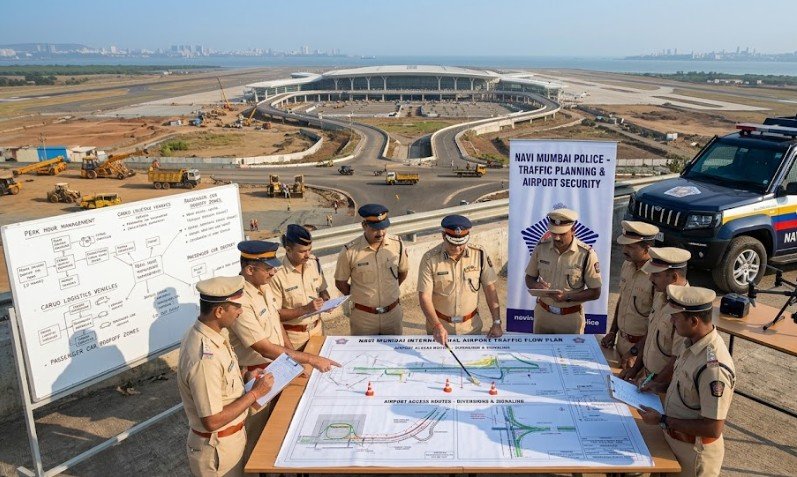
Authorities focus on smooth passenger movement as flight operations are expected to increase.
The Plan
With flight operations at Navi Mumbai International Airport (NMIA) expected to increase, the Navi Mumbai Police have begun preparations to manage the expected rise in traffic around the airport.
Police officials are working on a detailed traffic management plan, particularly for passengers travelling to the airport from Mumbai and Thane. The focus is on identifying busy routes, possible congestion points and measures to ensure smoother movement of vehicles. The opening of NMIA is expected to significantly change traffic patterns in Navi Mumbai and neighbouring areas. With more passengers and vehicles expected on the roads, authorities are looking at ways to prevent traffic bottlenecks, especially during peak hours.
The police are also considering the possible movement of some flights from Chhatrapati Shivaji Maharaj International Airport in Mumbai to NMIA. Any such shift could further increase passenger traffic towards Navi Mumbai.
Officials are therefore assessing key approach roads and planning traffic diversions and other measures wherever required. The aim is to ensure that passengers can reach the airport without unnecessary delays while regular commuters and local residents are also able to travel smoothly. For Navi Mumbai residents, the new airport is expected to bring major economic and connectivity benefits, but managing the additional traffic will be equally important.
Police preparations are aimed at ensuring that the growing airport activity does not lead to major traffic problems and that the new airport remains easily accessible for passengers from across the Mumbai Metropolitan Region.
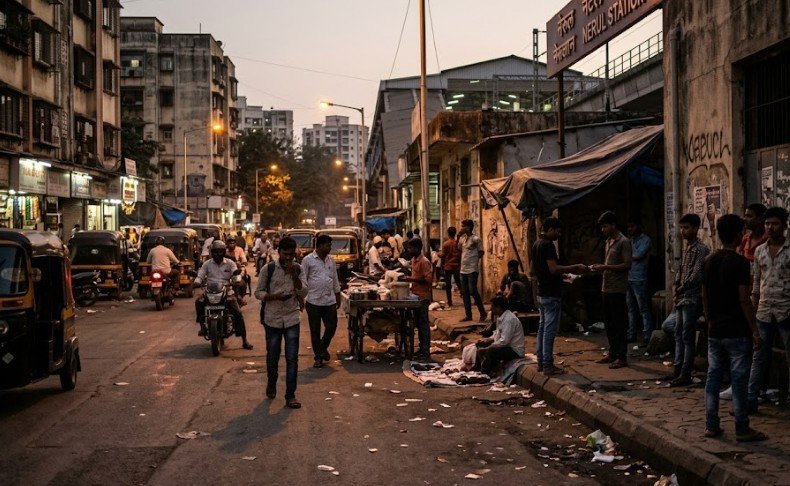
CIDCO urged to hand over open land to NMMC for better maintenance and development.
The Activities
The area outside Nerul Railway Station on the western side has become a growing concern for residents and commuters due to poor maintenance and alleged illegal activities. Issues such as unauthorised parking, garbage accumulation, the presence of homeless people and suspected drug-related activities have raised safety concerns, particularly among women using the station.
To address the problem, efforts are being made to transfer the open land from CIDCO to the Navi Mumbai Municipal Corporation (NMMC). The move is expected to allow the civic body to take up cleanliness, beautification, parking management and other development work in the area.
A meeting was held in the presence of a state minister following an initiative by corporator Girish Mhatre. The safety and development of the area around the station were discussed during the meeting. The NMMC Commissioner has also formally requested CIDCO to hand over the land to the civic body. Residents hope that the transfer will lead to better upkeep and make the area safer and more accessible for commuters. Improved lighting, cleanliness, organised parking and regular monitoring could help address several of the existing concerns.
The meeting also discussed houses located along the railway tracks that have existed since before 2000. Authorities decided to hold off on immediate action against these residents while working towards a permanent solution. For daily commuters, residents say the priority is simple—turn the neglected space around the station into a clean, organised and safe public area.

Navi Mumbai ACB Arrests Inspector, Security Guard in ₹43,000 Bribe Case

Navi Mumbai Police Prepare Traffic Plan for New International Airport

Nerul Station Area Faces Safety Concerns Over Illegal Activities

Nidhi Razdan, fake Harvard professorship, and here is the explanation through her blog.

As the arrangement with Prashant Kishor falls through Rahul Gandhi has gone overseas again and is uncontactable

BSNL reveals all new 4G plans starting at ₹16

-
 Fact Check6 years ago
Nidhi Razdan, fake Harvard professorship, and here is the explanation through her blog.
-
 India4 years ago
As the arrangement with Prashant Kishor falls through Rahul Gandhi has gone overseas again and is uncontactable
-
 Technology5 years ago
BSNL reveals all new 4G plans starting at ₹16
-

 Latest News5 years ago
Government has spent ₹9,725 crores on Covid-19 vaccination drive so far
-

 Latest News5 years ago
Tata wins Air India with ₹18,000 crore bid
-

 Latest News5 years ago
Jharkhand government cuts Petrol price by massive ₹25 a litre but with a catch
-

 Latest News5 years ago
Raj Kundra Gave ₹25 Lakh Bribe to Mumbai Crime Branch to Avoid Arrest
-

 Navi Mumbai5 years ago
Navi Mumbai civic body raids and tests morning walkers, many found COVID positive