
India
Punjab set to provide 300 free units of electricity every month


From July 1, every home in Punjab will receive 300 free units of power each month, according to Chief Minister Bhagwant Mann, who announced this on Saturday as his government completed its first month in office.
He stated that, except for scheduled caste and backward class families, if energy consumption exceeds 600 units in two months, the consumer will be responsible for the entire bill.
Scheduled Castes, backward castes, below-poverty-line households, and liberation warriors will now receive 300 units of power per month instead of 200. However, the chief minister explained that if their electricity consumption surpasses 600 units in two months, they will only be charged for the excess 600 units.
“Punjabi households will receive 300 units of free electricity each month starting July 1, 2022. For the next two months, it will be 600 units “In a video message on Saturday, the chief minister said. The billing cycle for electricity in Punjab is two months.
On Saturday morning, the state’s information and public relations department placed adverts in numerous newspapers with the statement.
During the Punjab assembly elections, this was one of the Aam Aadmi Party’s major election promises. In June of last year, Arvind Kejriwal, the party’s national leader, promised the state free electricity for up to 300 units.
Every hamlet and town in Punjab would have access to power 24 hours a day, seven days a week, according to Punjab’s chief minister.
Mann also announced that those houses with a two-kilowatt load will have their electricity costs waived until December 31, 2021. Furthermore, he stated that there would be no rise in the electricity cost for industrial and commercial customers, while the farming community would continue to get free power.
In two to three years, the Punjab chief minister claimed, his government would provide round-the-clock energy to every hamlet and town. He also stated that his government would supply the state’s residents with the cheapest electricity in the country.
Raghav Chadha, an AAP politician, and Rajya Sabha MP stated in a tweet that what was promised has been fulfilled and that the people of Punjab, like those in Delhi, will now have access to free power.
Mann had claimed in Jalandhar on Thursday that “positive news” would be revealed on April 16.
On Tuesday, he met with Arvind Kejriwal, the Delhi Chief Minister, in the national capital to discuss the details of supplying free power to up to 300 units in Punjab. Kejriwal also met with senior Punjab officials, including Chief Secretary Anirudh Tewari, to discuss free power.
Punjab Congress is dissatisfied with the slow pace at which a campaign pledge is being implemented.
Congress leaders, on the other hand, mocked the AAP government’s statement, with party MLA Sukhpal Singh Khaira questioning Mann why free electricity would be provided just till July and whether power users would have to pay the full bill if their use exceeded 300 units.
In a tweet, the Bholath MLA wrote: “I congratulate Bhagwant Mann on delivering on his pledge of 300 free power units, but why wait until July 1? Is there a problem with the way money is handled? Also, will the clients be charged the whole bill if the bill is for 301 units? Finally, will the tubewell subsidy be phased out?”
Amarinder Singh Raja Warring, the Punjab Congress chief, tweeted, “The proof of the pudding, Bhagwant Mann Ji, is in the eating… The authenticity of your 300 unit free power, as well as the conditions tied to it, will be thoroughly examined… Best of luck to PSPCL, who must now find a way to survive.”


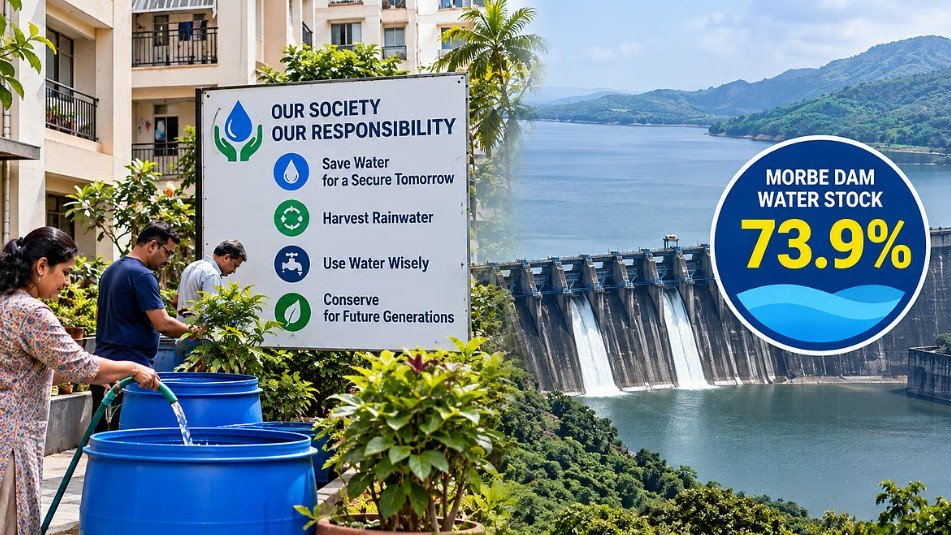
With Morbe Dam’s water stock at 73.9%, housing societies are adopting practical measures to reduce wastage and protect the city’s drinking water supply.
The Conservation
With water storage at Morbe Dam falling to 73.9%, housing societies across Navi Mumbai are stepping up conservation efforts to prevent unnecessary wastage and prepare for the coming months.
Several societies have introduced simple measures to reduce their dependence on the municipal water supply. These include using borewell water for non-drinking purposes, preventing tank overflows and encouraging residents to use water responsibly.
In Nerul, Bhimashankar Society has dug three borewells to provide water for activities such as vehicle washing and gardening. The society has 763 flats and 948 vehicles, making water conservation an important priority. In Belapur, Parsik Green Association is discouraging residents from washing cars with municipal drinking water. It is also monitoring storage tanks to prevent overflow and supports using treated wastewater for maintaining gardens.
Similarly, Samata Society in Sanpada has urged residents to be mindful of their daily water consumption, particularly while watering plants and using washing machines. The Navi Mumbai Municipal Corporation (NMMC) has also warned against using drinking water for vehicle washing and construction activities. Violators may face penalties and other action, including disconnection of the water supply.
The civic body has appealed to residents to repair leaking taps and pipelines, prevent water tanks from overflowing and avoid unnecessary consumption. As Morbe Dam remains the city’s main source of drinking water, the cooperation of housing societies and residents will be crucial in ensuring that available water is used wisely and the city’s supply remains secure.
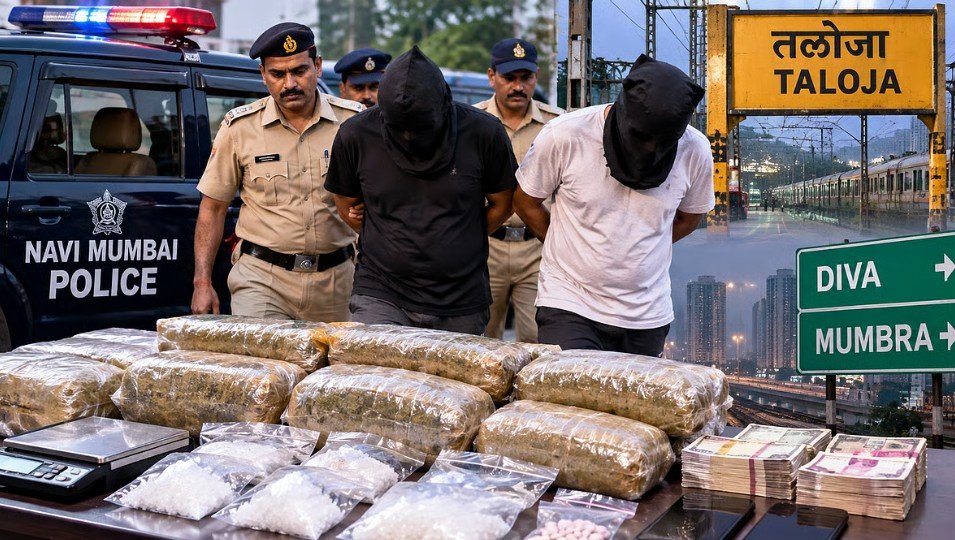
The latest arrests from Diva-Mumbra have helped investigators trace alleged drug supply links as police continue to probe the network and its financial transactions.
The Case
Navi Mumbai Police have arrested two more suspects in connection with a drug seizure worth Rs 3.57 crore in Taloja, taking the total number of arrests in the case to three.
The Anti-Narcotics Cell arrested Destiny Akachukwu Ugochukwu, 34, a Nigerian national, and Poonam Basnet, 30, from the Diva-Mumbra area on October 14. Police suspect that the two were linked to the supply network behind the seized drugs.
The investigation began on October 8, when officers arrested Ani Ikechukwu Darlington, 41, in Taloja. Police allegedly recovered 2.497 kg of mephedrone, commonly known as MD, and 566 grams of cocaine from his possession and residence. The seized drugs were valued at Rs 3.57 crore. Further questioning and investigation reportedly helped police trace the alleged supply links to the two newly arrested suspects.
Investigators are also examining financial transactions connected to the case. Police suspect that QR codes linked to a bank account may have been used to collect payments for drug deals. The two accused have been remanded to police custody for further questioning. Police are now working to identify the source of the drugs, their intended recipients and others who may have been involved in the alleged network. The investigation is ongoing, and officials are examining financial records and other evidence to establish the full extent of the suspected drug operation.
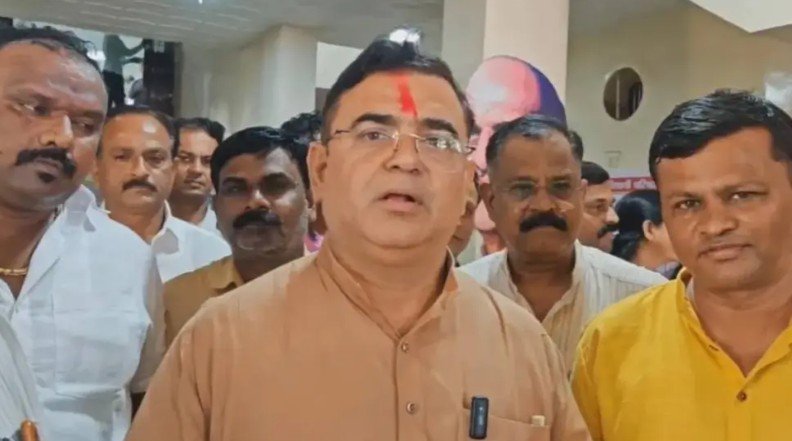
The decision aims to help farmers recover pending payments from traders, while a move towards digital transactions seeks to improve transparency in the market.
The Relief
In a major relief for farmers, the Mumbai Agricultural Produce Market Committee (APMC) has removed the six-month deadline for filing complaints against traders over unpaid dues and other irregularities. The decision was taken at an executive board meeting on October 15, chaired by Maharashtra Marketing Minister and APMC Chairman Jaykumar Rawal.
Earlier, farmers had to file complaints within six months if traders failed to pay them for their produce or if they faced issues related to weighing. Those who missed the deadline often found it difficult to recover their money. With the new decision, farmers will be able to approach the market committee even after six months, giving them another opportunity to seek justice and recover long-pending payments.
The minister emphasised that recovering farmers’ outstanding dues would remain a priority. Officials will also examine questionable transactions and transfers carried out without the required approvals. In another step towards improving transparency, the APMC has directed officials to begin digitizing market transactions within seven days. Banks, including HDFC and ICICI, are being approached to suggest suitable digital systems.
The proposed digital system is expected to make transactions easier to monitor and help reduce irregularities in the market. The removal of the deadline is expected to benefit farmers who have struggled to recover their payments. However, the effectiveness of the move will ultimately depend on how quickly complaints are addressed and outstanding dues are recovered.

Navi Mumbai Housing Societies Step Up Water Conservation as Morbe Dam Storage Falls

Navi Mumbai Police Arrest Two More Suspects in Rs 3.57 Crore Taloja Drug Case

APMC Removes Six-Month Deadline for Farmers’ Complaints

Nidhi Razdan, fake Harvard professorship, and here is the explanation through her blog.

As the arrangement with Prashant Kishor falls through Rahul Gandhi has gone overseas again and is uncontactable

BSNL reveals all new 4G plans starting at ₹16

-
 Fact Check6 years ago
Nidhi Razdan, fake Harvard professorship, and here is the explanation through her blog.
-
 India4 years ago
As the arrangement with Prashant Kishor falls through Rahul Gandhi has gone overseas again and is uncontactable
-
 Technology5 years ago
BSNL reveals all new 4G plans starting at ₹16
-

 Latest News5 years ago
Government has spent ₹9,725 crores on Covid-19 vaccination drive so far
-

 Latest News5 years ago
Tata wins Air India with ₹18,000 crore bid
-

 Latest News5 years ago
Jharkhand government cuts Petrol price by massive ₹25 a litre but with a catch
-

 Latest News5 years ago
Raj Kundra Gave ₹25 Lakh Bribe to Mumbai Crime Branch to Avoid Arrest
-

 Navi Mumbai5 years ago
Navi Mumbai civic body raids and tests morning walkers, many found COVID positive