
India
Bihar will ban diesel-powered automobiles and buses in Patna vehicle owners are concerned


With effect from April 1, 2022, the Bihar Transport Department has banned all diesel-powered buses and vehicles in the state capital, Patna. According to a recent tweet from news agency ANI, all diesel-powered buses and automobiles will be outlawed on April 1st.
According to the news agency, a bus driver said, “What will we do if we are shut down? We’re going to have a tough time. Buses have been running for ten years and are currently being phased out.”
Efforts have been made to reduce air pollution.
The decision was made in response to rising air pollution in Patna, Bihar’s capital city. The administration had decided to make the transition earlier in 2019, but it was postponed owing to the COVID-19 pandemic. Sanjay Kr Agarwal, Bihar Transport Secretary, recently asserted that the division was able to implement the deadline from April 1 after it was extended twice owing to COVID-19, justifying the ban placed on diesel-run buses and vehicles.
The Bihar Transport Secretary explained the delay by saying that the Central government has decided to ban diesel cars from Patna’s roadways in 2019 to combat rising air pollution. However, because of the COVID-19 epidemic, its deployment was postponed.
It was also announced that diesel-powered buses and auto-rickshaws will be prohibited from operating within the Patna Municipal Corporation’s city limits and the semi-urban areas of Danapur, Khagaul, and Phulwarisharif.
Nitish Kumar, the Chief Minister of Bihar, discusses the state’s increasing air pollution.
Nitish Kumar, the Chief Minister of Bihar, has previously stated that diesel-powered automobiles pollute the air. Farmers who burn stubble will be ineligible for state agricultural subsidies, he was also overheard stating. He’d also asked investigators to look into whether the brick kilns were using the most up-to-date pollution control methods.
As a result of farmers burning stubble to dispose of their crops, the air quality in several towns in north India is deteriorating, particularly in Bihar.
On March 22, the state commemorated Bihar Diwas, and this year’s theme was Jal, Jeevan, Hariyali, to emphasize the significance of a pollution-free environment.


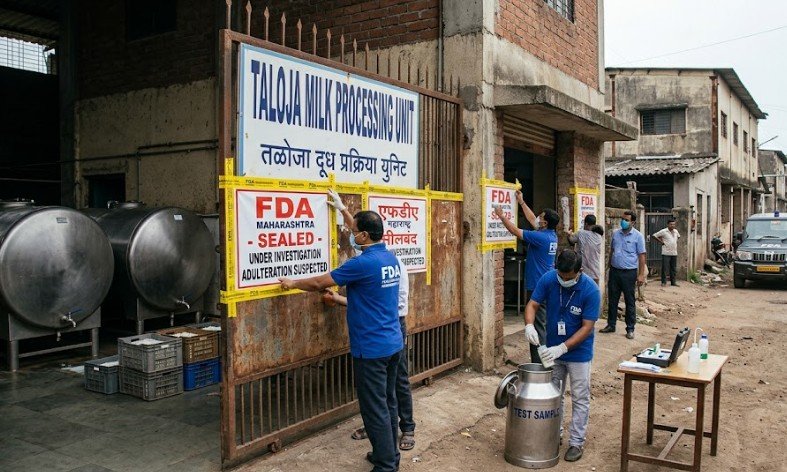
Authorities destroy 1,494 litres of suspected adulterated milk and register a criminal case against six people following inspections in Panvel.
The Adulteration
The Food and Drug Administration (FDA) has suspended the licences of three dairy units in the Taloja industrial area of Panvel following inspections that reportedly revealed violations of food safety and hygiene standards. The action was taken against Mateshwari Foods, Sawariya Milk and Milk Products, and Royal Foods, located in Balaji Industrial Park, Taloja.
During the inspection, FDA officials destroyed 1,494 litres of suspected adulterated milk and seized curd for further examination. Samples have been sent for laboratory testing, and further action will depend on the test results. A criminal case has also been registered against six people at Taloja police station. They are accused of involvement in the production, storage and sale of adulterated food products, raising concerns about the safety of dairy products supplied to consumers.
The FDA’s action highlights the importance of maintaining proper hygiene and following food safety regulations in dairy processing units. Authorities are investigating the matter, and further steps may be taken based on the findings. The incident has also raised concerns about the quality of milk and milk products available in the market, underlining the need for regular inspections to protect public health.
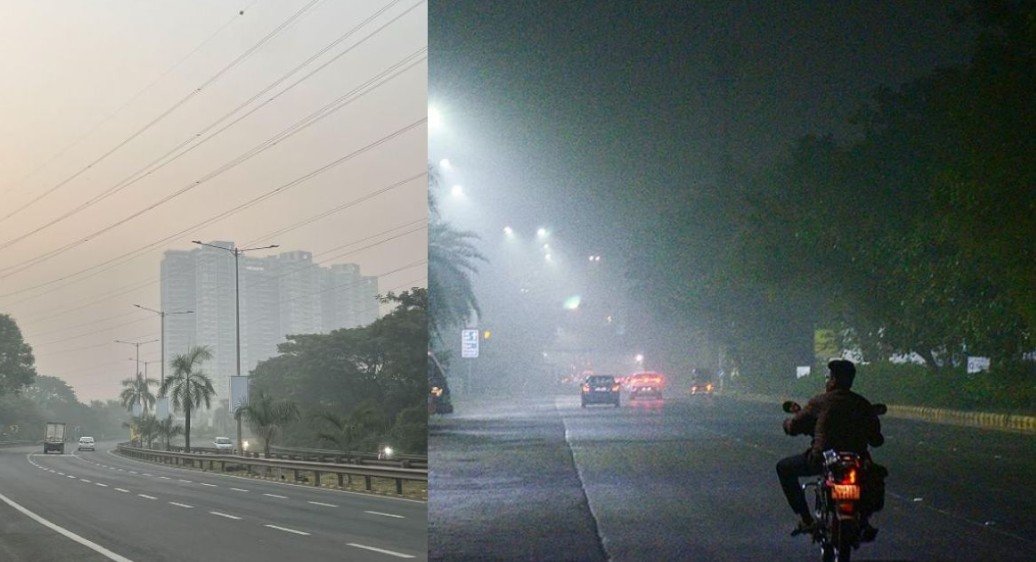
Mahape records the city’s highest AQI at 141, while environmentalists call for stricter action and improved pollution standards.
The Demand
Air pollution continues to be a concern in Navi Mumbai, with the Air Quality Index (AQI) remaining above 100 since October 16. According to the Central Pollution Control Board’s (CPCB) National Air Quality Data Management System, the city recorded an AQI of 121 at 2.05 pm on October 19. Mahape reported the highest AQI at 141, while the monitoring station in Sector 2E, Kalamboli, recorded the lowest at 103. Other locations also registered elevated readings, including CBD Belapur (133), Koparipada-Vashi (131), Tondare-Taloja (125), Sanpada (115) and Nerul (109). PM10 and PM2.5 were among the prominent pollutants recorded in CBD Belapur.
Environmental activist BN Kumar criticised the administration’s response, stating that rising pollution levels reflected inadequate regulation of construction activities, vehicle emissions and industrial pollution. He urged residents to demand accountability and concrete measures to protect public health and the environment. Activists have also questioned the difference between India’s AQI classification and that of the United States. Under India’s system, readings between 101 and 200 are classified as ‘Moderately Polluted’. In the US, readings of 101–150 fall under ‘Unhealthy for Sensitive Groups’.
Jyoti Nadkarni, a Kharghar-based resident and environmental activist, called for India to upgrade its pollution standards and give environmental protection greater priority. The elevated AQI levels raise concerns for children, senior citizens and people with respiratory or cardiovascular conditions, who are particularly vulnerable to the effects of air pollution.
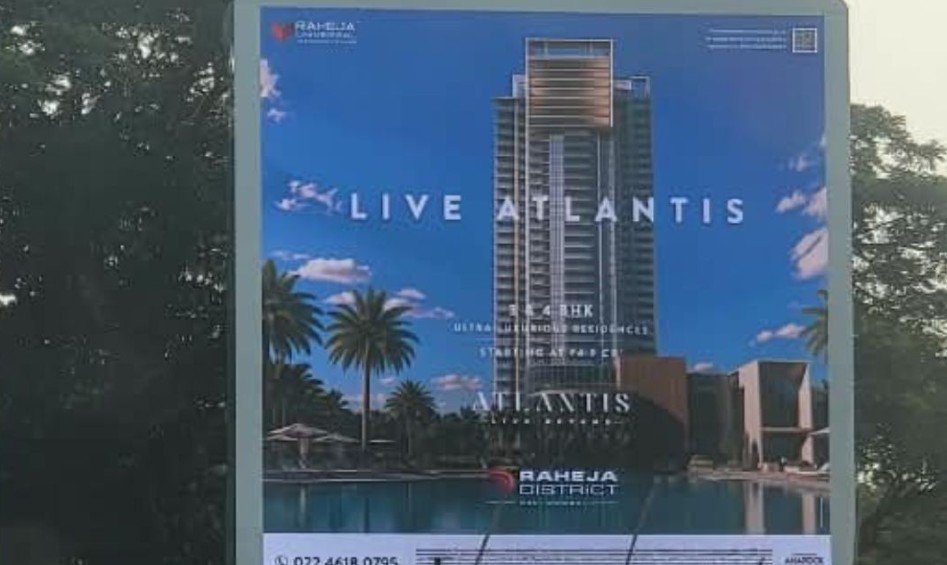
Activists question the legality of installations, citing possible tender violations, road safety risks and lack of civic permissions.
The Hoardings
Giant digital hoardings installed at prominent junctions along Palm Beach Road have sparked controversy over alleged tender violations, road safety and civic accountability. Environmental activists and advertising agencies have questioned whether the installations comply with the Navi Mumbai Municipal Corporation’s (NMMC) advertising contract.
The five-year contract awarded to M/s Ronak Advertising Agency reportedly covers 36 existing hoardings at 30 public and community toilet locations across the city. The agency is said to pay the civic body approximately Rs 2.25 crore annually. However, allegations have emerged that large digital displays have been installed at prominent Palm Beach Road junctions beyond the locations specified in the contract. Activists have demanded an investigation into the permissions granted and compliance with the tender conditions. Local MLA Manda Mhatre had earlier objected to the installation of large hoardings near traffic signals and reportedly sought cancellation of the contract.
Activists have also warned that bright, illuminated displays featuring changing advertisements could distract motorists at busy junctions and increase road safety risks. Questions have additionally been raised about structural safety inspections and compliance with applicable regulations. Environmental activist Bhaskar Machhare said a delegation of activists and advertising contractors had met the municipal commissioner to raise concerns over the allegedly unauthorised installations.
According to Machhare, the commissioner clarified that he had not granted permission for the hoardings and directed the concerned officials to take immediate action. The controversy has intensified demands for a thorough inquiry into the approval process and the role of officials responsible for regulating outdoor advertisements. The civic body’s response and any action against the disputed structures are now being closely watched.

FDA Suspends Three Dairy Units in Taloja Over Suspected Milk Adulteration

Navi Mumbai AQI Remains Above 100, Activists Demand Stronger Pollution Control

Giant Digital Hoardings on Palm Beach Road Raise Tender Violation Concerns

Nidhi Razdan, fake Harvard professorship, and here is the explanation through her blog.

As the arrangement with Prashant Kishor falls through Rahul Gandhi has gone overseas again and is uncontactable

BSNL reveals all new 4G plans starting at ₹16

-
 Fact Check6 years ago
Nidhi Razdan, fake Harvard professorship, and here is the explanation through her blog.
-
 India4 years ago
As the arrangement with Prashant Kishor falls through Rahul Gandhi has gone overseas again and is uncontactable
-
 Technology5 years ago
BSNL reveals all new 4G plans starting at ₹16
-

 Latest News5 years ago
Government has spent ₹9,725 crores on Covid-19 vaccination drive so far
-

 Latest News5 years ago
Tata wins Air India with ₹18,000 crore bid
-

 Latest News5 years ago
Jharkhand government cuts Petrol price by massive ₹25 a litre but with a catch
-

 Latest News5 years ago
Raj Kundra Gave ₹25 Lakh Bribe to Mumbai Crime Branch to Avoid Arrest
-

 Navi Mumbai5 years ago
Navi Mumbai civic body raids and tests morning walkers, many found COVID positive