
Latest News
A Banker Jumps From Atal Setu In Mumbai, And His Body Is Found Near Navi Mumbai


Body of a banker found near Navi Mumbai.
Case in Detail
According to authorities, a 40-year-old banker’s body was found on the shore of Navi Mumbai on Tuesday after he stopped his car on Atal Setu in Mumbai and dove into the water.
Sushant Chakravarti has been recognized as the man. Chakravarti’s identity was verified by authorities, and the JNPT police in Navi Mumbai filed an Accidental Death Report (ADR) and started an additional inquiry.
CCTV footage, the watch he was wearing, the car keys, and the ring on his hand all helped to authenticate his identification. His family was then notified by the police. Information about Chakravarti jumping into the water from the Atal Setu bridge was reported to the Shivdi police. When they got to the scene, they found a car parked where he had leaped—at the edge of the bridge.
Subsequent examination indicated that Chakravarti was the owner of the car. He worked as a deputy manager at a government bank at Hutatma Chowk, Mumbai’s Fort district, and resided in the Parel neighborhood of the city with his wife and daughter. The Shivdi police invited Chakravarti’s wife to the police station for questioning. She told them that he had spent the last few days under stress at work. But there was no suicide note or any other relevant material on his cell phone.
On Monday morning, Chakravarti left home, saying he was going to work. He went to Atal Setu and dove into the sea rather than going to the bank. Atal Setu control room CCTV footage showed that the event happened around 9:57 AM. Speedboats were sent in to assist with the search for him as soon as rescue personnel arrived on the scene.






New system aims to improve transparency and water distribution amid a 50 MLD supply shortage across CIDCO areas.
The Dashboard
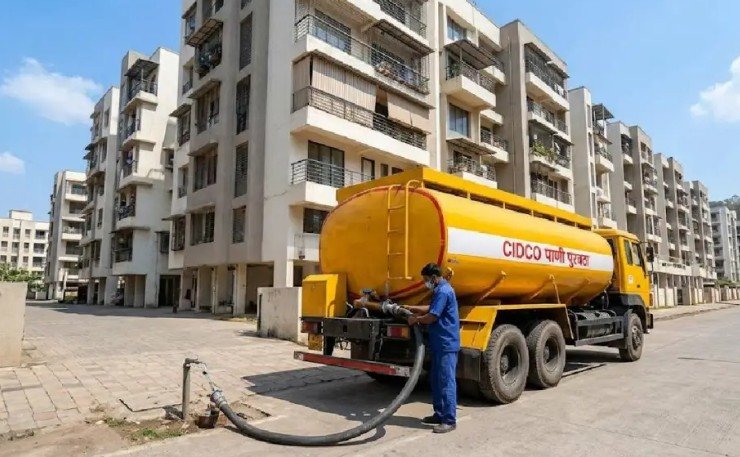
The City and Industrial Development Corporation (CIDCO) has introduced a digital dashboard to monitor water tanker operations in Kharghar and Taloja, where residents are facing water shortages due to reduced supply.
The dashboard will track residents’ complaints, tanker requests, delivery schedules and the number of trips made to housing societies. Assistant engineers will verify water shortages by checking water meter readings, while society representatives will confirm deliveries after tankers arrive. According to the report, 14 tankers make around 140 trips daily in Kharghar and Taloja. Across the wider CIDCO area, 40 tankers are expected to make approximately 280 to 300 trips every day.
CIDCO’s total water requirement stands at around 361 million litres per day (MLD), against the current supply of approximately 311 MLD, resulting in a shortfall of 50 MLD. The shortage has particularly affected housing societies located on higher ground and at the ends of water distribution networks, where low pressure often disrupts supply.
CIDCO bears the transportation costs for tanker deliveries, while residents are charged ₹125 for every 10,000 litres of water supplied. The new dashboard is expected to improve monitoring, ensure transparency and help authorities distribute water more efficiently. However, residents may continue to depend on tankers until the gap between water demand and supply is reduced.

Vashi APMC market records a price increase of Rs 200 to Rs 600 per kg, putting pressure on festive shopping budgets.
The Prices
Dry fruit prices have increased significantly ahead of Diwali, making festive shopping more expensive for consumers. Wholesale prices at the Vashi Agricultural Produce Market Committee (APMC) market have risen by around Rs 200 to Rs 600 per kg compared to last year. The price rise is expected to affect households preparing Diwali sweets and snacks, as well as those purchasing dry fruit gift boxes for relatives, friends and employees.
According to market rates, green pistachios are selling at Rs 3,000 to Rs 3,200 per kg, while almonds cost Rs 1,100 to Rs 1,500 per kg. Cashew prices range from Rs 950 to Rs 1,500 per kg, while walnuts are priced between Rs 900 and Rs 2,200 per kg. Dried figs are selling at Rs 1,000 to Rs 2,400 per kg. Premium dry fruits are even more expensive, with pine nuts costing Rs 5,600 to Rs 6,000 per kg. Meanwhile, blueberries are priced at Rs 1,400 to Rs 1,600 per kg and cranberries at Rs 600 to Rs 800 per kg.
Traders have attributed the increase to supply shortages in international markets, import duties and rising transportation costs. Supplies from countries such as Iran and the United States have reportedly been affected, while arrivals at ports have remained lower than expected. With Diwali shopping underway, consumers may need to spend more on traditional festive preparations and gift hampers this year.

Transport Committee extends ex-gratia grant to permanent and contract workers without attendance-based conditions, daily revenue rises from Rs 27 lakh to Rs 40 lakh.
The Bonus
The Navi Mumbai Municipal Transport (NMMT) committee has approved an ex-gratia grant of Rs 45,000 for all permanent and contract-based employees, following a decision taken at a meeting chaired by Transport Committee Chairman Vikas Jhanjhad.
The grant has been approved on the lines of the Navi Mumbai Municipal Corporation (NMMC). According to Vikas Jhanjhad, the benefit will be extended to all employees, including daily-wage workers, without conditions based on the number of days they have worked. Arrangements are being made to ensure the amount is credited to employees’ bank accounts before Diwali.
Vikas Jhanjhad said the committee has focused on improving NMMT’s financial performance and services over the past seven months. As a result, the transport undertaking’s daily revenue has increased from Rs 27 lakh to around Rs 40 lakh, while its losses have also declined.
He added that NMMT operates around 2.25 lakh passenger journeys daily, including approximately one lakh women passengers who benefit from discounted fares. The committee has also increased bus services and strengthened the fleet to improve public transport. In another revenue-generating initiative, NMMT has returned a 21,450-square-foot property in Sector 12, which had been allotted to the Ministry of Corporate Affairs. The property is expected to generate additional income through rent at Rs 150 per square foot.
Vikas Jhanjhad said the committee’s priorities include protecting employees’ interests, improving passenger services and strengthening the undertaking’s financial position by identifying and developing new revenue sources.

CIDCO Launches Digital Dashboard to Monitor Water Tankers in Kharghar and Taloja

Dry Fruit Prices Rise Ahead of Diwali in Navi Mumbai

NMMT Approves Rs 45,000 Diwali Bonus for All Transport Employees

Nidhi Razdan, fake Harvard professorship, and here is the explanation through her blog.

As the arrangement with Prashant Kishor falls through Rahul Gandhi has gone overseas again and is uncontactable

BSNL reveals all new 4G plans starting at ₹16

-
 Fact Check6 years ago
Nidhi Razdan, fake Harvard professorship, and here is the explanation through her blog.
-
 India5 years ago
As the arrangement with Prashant Kishor falls through Rahul Gandhi has gone overseas again and is uncontactable
-
 Technology5 years ago
BSNL reveals all new 4G plans starting at ₹16
-

 Latest News5 years ago
Government has spent ₹9,725 crores on Covid-19 vaccination drive so far
-

 Latest News5 years ago
Tata wins Air India with ₹18,000 crore bid
-

 Latest News5 years ago
Jharkhand government cuts Petrol price by massive ₹25 a litre but with a catch
-

 Latest News5 years ago
Raj Kundra Gave ₹25 Lakh Bribe to Mumbai Crime Branch to Avoid Arrest
-

 Navi Mumbai6 years ago
Navi Mumbai civic body raids and tests morning walkers, many found COVID positive