
India
Parliamentary panel says the Census should not just be data-driven

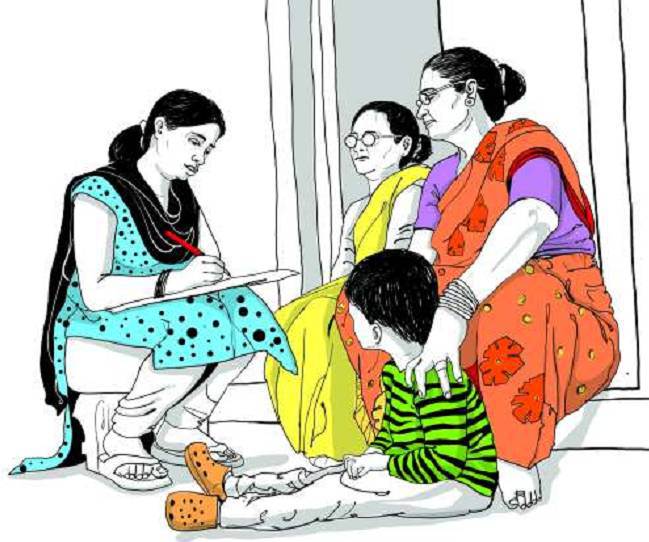
The pan-India decadal census, according to a parliamentary standing committee on home affairs, should not just be data-driven, but should also convey the perspective of culture and society, as it did before Independence.
It has advised that the Registrar General of India (RGI) form a separate expert panel to analyze the census pattern since its inception and suggest strategies to bring qualitative change to the census exercise so that the country’s socio-cultural diversity is truly represented in the census.
“At a meeting on February 14, 2022, the group discussed how the census should convey the perspective of culture and society rather than just collecting data. The 238th report of the department-related parliamentary standing committee on home affairs, headed by Congress leader Anand Sharma, stated that “since the current census has not yet begun, an effort should be made on the part of the ministry (of home affairs) through the RGI to obtain data on such parameters as was being collected/reflected in the census reports in the pre-independence era,”
“As a pan-India decadal activity, the census should present the culture, traditions, and diversity of the country’s various regions alongside the numerical data,” it added. On Monday, the report was presented to Parliament.
The committee cites an increase in the number of questions in the census questionnaire as the primary reason for its call for a fresh approach to the decennial exercise.
In a meeting on February 14 this year, the committee members also highlighted that the provincial registrars/officers, as well as the RGI, have not published an annual report on the census procedure for the past few censuses. It has requested that the Ministry of Home Affairs (MHA) resume the release of annual reports beginning with the next census.
However, a former RGI disagreed with the committee. “The census already captures several characteristics of Indian society such as distinct cultures in different regions, economic background, languages, etc,” the retired RGI added, requesting anonymity. I’m not sure what further could be done.”
He stated that the 2011 Census annual report had been created, but that the reasons for not publishing it were best known to the present census administration and the MHA.
Due to the coronavirus epidemic, the Census 2021, which is a two-part exercise, has been postponed indefinitely. The first phase, known as house listing, was set to run from April 1 to September 30, 2020, while the second phase, known as Population Enumeration, was set to begin in February 2021.
The next census will be the first digital census, with enumerators collecting and submitting data directly from their smartphones via a mobile app. In the event of connectivity problems, a paper schedule is also available.
As a result, the government announced last week that self-enumeration will be available online throughout both stages of the Census.


Residents say unreliable CIDCO supply is forcing them to spend lakhs every month on water.
The Crisis
More than 350 families living in Akshar Estonia, Sector 47, Dronagiri, are struggling with an unreliable water supply and have been forced to depend on private tankers to meet their daily needs.
Residents claim that the CIDCO water supply, provided on alternate days, is insufficient and often comes with low pressure. As a result, the society has reportedly been spending around Rs 5 lakh every month on tanker water. Residents estimate that the expenditure has reached nearly Rs 1.5 crore over the past three years.
According to residents, the low pressure often prevents their underground water tanks from filling adequately. Technical issues in the main pipeline receiving water from the Hetawane dam, along with frequent supply interruptions, have further added to their difficulties. K.N. Bhat, president of the housing society, said residents have repeatedly approached CIDCO seeking a permanent solution, but the problem continues. He said the society is now considering legal action if the water shortage is not resolved.
The crisis has made everyday household activities difficult for families, while some residents have also raised concerns about the quality and safety of tanker water. Residents said that while Dronagiri is developing rapidly and more families are moving into the area, the water infrastructure has not kept pace with the growing population.
They have urged CIDCO to strengthen the water-supply network and provide a reliable long-term solution so that families are not forced to depend on expensive tankers for a basic necessity.
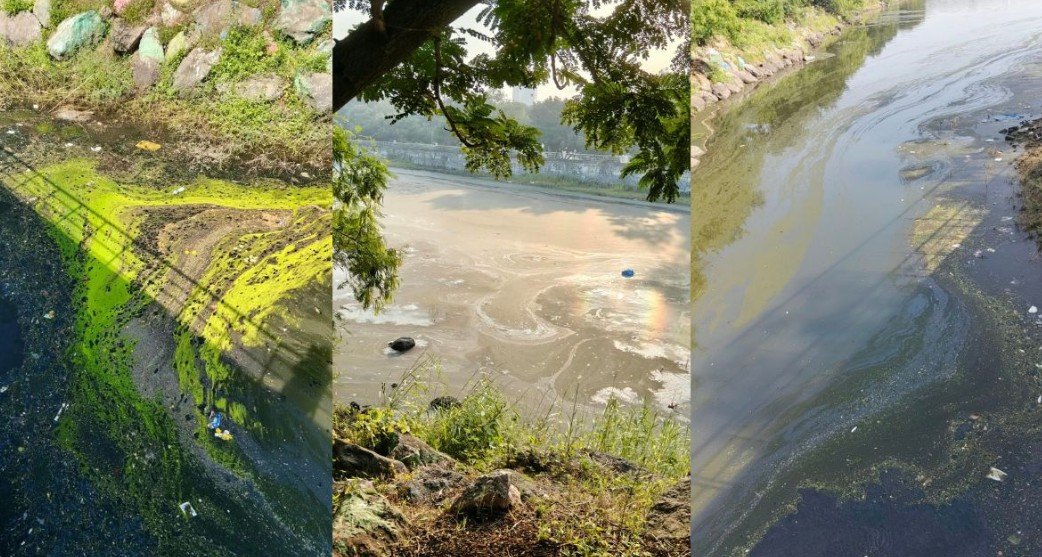
Environmental group flags construction debris, while residents complain of dust and inconvenience.
The Pond
Ongoing work on the walking track near Mini Seashore in Vashi’s Sector 9A has raised concerns over the condition of a nearby holding pond. Environmentalists and local residents have alleged that construction debris is being dumped near the pond, adding to the pressure on an already troubled water body.
The pond has reportedly been facing issues such as algae growth, polluted water and foul odour. Earlier incidents of fish deaths had also raised concerns about the health of the pond’s ecosystem. Environmental organisation NatConnect Foundation has urged the Navi Mumbai Municipal Corporation (NMMC) to take immediate action and ensure that construction waste is disposed of properly. The organisation also stressed the need to make workers aware of the environmental impact of dumping debris near water bodies.
NMMC officials have assured that the matter will be inspected. Vashi ward officer Sukhdev Yedve said an engineer would visit the site and appropriate instructions would be given to the contractor regarding the disposal of construction material. Meanwhile, regular walkers have complained that the ongoing work is making their daily routine difficult. Excavation and removal of paver blocks have reportedly created dust, making walking uncomfortable for residents.
Residents said development work is welcome, but it should not come at the cost of the pond or the surrounding environment. They urged the civic authorities to complete the project carefully while protecting the water body and keeping the walking area safe and clean.
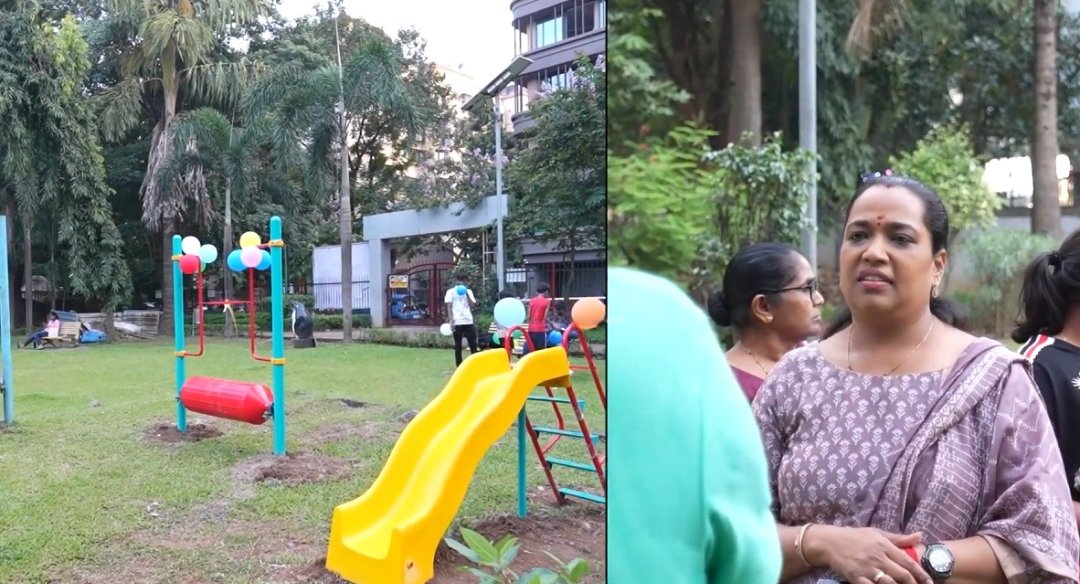
Sapna Gawde facilitates replacement of old and unsafe equipment at Dr Babasaheb Ambedkar Garden.
The Installation
Children in Seawoods Sector 42 now have a safer and more enjoyable space to play, with new playground equipment installed at Dr Babasaheb Ambedkar Garden in Nerul Ward No. 24. The old play equipment had been in poor condition for several years and had become unsafe for children. Residents had repeatedly raised concerns and requested that the damaged equipment be replaced.
Taking up the issue, local BJP corporator Advocate Sapna Gawde followed up with the Navi Mumbai Municipal Corporation (NMMC) through repeated correspondence and helped secure approval for installing new equipment.
The new facilities were inaugurated as part of Gawde’s birthday celebrations. In a special gesture, children themselves were invited to inaugurate the equipment, followed by a distribution of chocolates. The initiative brought visible excitement among the children and was appreciated by local residents.
Members of the Seawoods Residents Welfare Association thanked Gawde for ensuring that the old equipment, which was beyond repair, was replaced rather than merely repaired. Residents said the new playground could encourage children to spend more time outdoors and reduce their dependence on mobile phones. They also appealed to parents and children to use the equipment responsibly and help maintain the garden.
Sapna Gawde said that fulfilling the trust placed in her by residents remains her priority. She added that she would continue working to address civic concerns and improve facilities in the ward. She said the happiness of the children made the initiative one of the most meaningful parts of her birthday celebration.

Dronagiri Water Crisis Leaves 350 Families Dependent on Tankers

Walking Track Work Raises Concern Over Vashi Pond

New Play Equipment Installed at Seawoods Garden for Children

Nidhi Razdan, fake Harvard professorship, and here is the explanation through her blog.

As the arrangement with Prashant Kishor falls through Rahul Gandhi has gone overseas again and is uncontactable

BSNL reveals all new 4G plans starting at ₹16

-
 Fact Check6 years ago
Nidhi Razdan, fake Harvard professorship, and here is the explanation through her blog.
-
 India4 years ago
As the arrangement with Prashant Kishor falls through Rahul Gandhi has gone overseas again and is uncontactable
-
 Technology5 years ago
BSNL reveals all new 4G plans starting at ₹16
-

 Latest News5 years ago
Government has spent ₹9,725 crores on Covid-19 vaccination drive so far
-

 Latest News5 years ago
Tata wins Air India with ₹18,000 crore bid
-

 Latest News5 years ago
Jharkhand government cuts Petrol price by massive ₹25 a litre but with a catch
-

 Latest News5 years ago
Raj Kundra Gave ₹25 Lakh Bribe to Mumbai Crime Branch to Avoid Arrest
-

 Navi Mumbai5 years ago
Navi Mumbai civic body raids and tests morning walkers, many found COVID positive