
Latest News
PM Modi launches vehicles scrappage policy launched


Prime Minister Narendra Modi on Friday launched the vehicle scrappage policy and said that the policy is a significant milestone in India’s development journey. He urged youth and startups to join the programme.
“The launch of Vehicle Scrappage Policy today is a significant milestone in India’s development journey. The Investor Summit in Gujarat for setting up vehicle scrapping infrastructure opens a new range of possibilities. Our aim is to create a viable circular economy and bring value for all stakeholders while being environmentally responsible I would request our youth and start-ups to join this programme,” tweeted PM Modi.
He also said that the policy will help phase out unfit and polluting vehicles in an environment-friendly manner during the video address. He said vehicles will not just be scrapped by their age but also if they are found to be unfit in automated testing.
As the name suggests, the policy will help in phasing out old, unfit vehicles. The scrappage policy will come into effect immediately after the registration period of a vehicle is over; it would then have to undergo a mandatory fitness test. As per motor vehicle laws in the country, a passenger vehicle has a life of 15 years and commercial vehicles have a lifespan of a decade.
Vehicles plying on the roads beyond these durations are considered to pollute the environment at a greater pace compared to newer cars. They are likely to feature old technology, making them unsafe for usage on roads. These vehicles also consume more fuel compared to newer vehicles. The scrappage policy will help modernise the vehicle fleet and will ensure the scientific disposal of old polluting vehicles.

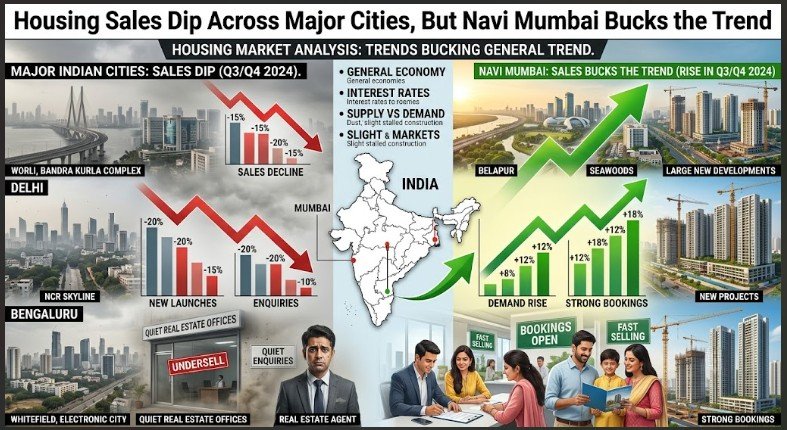
Home sales fell 6% in the July–September quarter, while Navi Mumbai recorded a 12% rise in demand.
The Dip
The housing market across India’s major cities saw a slowdown in the July–September quarter, but Navi Mumbai stood out with a rise in home sales.
According to a PropEquity report, housing sales across nine major cities fell by 6% year-on-year, with around 1.03 lakh homes sold during the quarter. Several major markets recorded a decline, including Pune, Chennai, Thane, Mumbai and Delhi-NCR.
Navi Mumbai, however, moved in the opposite direction. The city recorded a 12% increase in housing sales, with around 9,810 units sold, compared with 8,730 units during the same period last year. Hyderabad also reported an increase, while Bengaluru remained almost stable. The growth in Navi Mumbai comes despite the broader slowdown in the housing market.
New housing launches also declined during the quarter, indicating that developers are becoming more cautious about adding fresh inventory. Across the nine cities, about 98,165 new housing units were launched, lower than the previous year. Industry experts said the July–September period is generally affected by the monsoon, which can temporarily slow homebuying activity. The festive season from October onwards is expected to bring renewed interest from buyers, with developers likely to introduce new projects and promotional offers.
For Navi Mumbai, the rise in sales highlights continued demand for housing in the region, even as buyers in several other major cities remained more cautious.
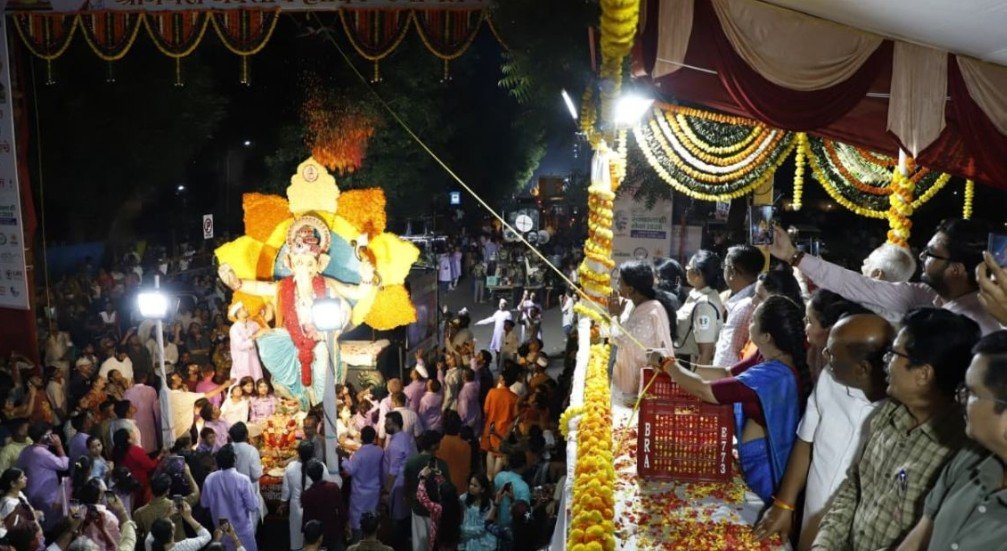
Thousands of devotees bid an emotional farewell to Bappa as civic teams ensured smooth and safe immersion arrangements.
The Visarjans
Navi Mumbai witnessed a grand and emotional conclusion to the 10-day Ganeshotsav as 8,573 Ganesh idols were immersed across the city on Anant Chaturdashi.
The immersion process continued through the night and was completed at around 5:30 a.m., with devotees turning up in large numbers to bid farewell to Lord Ganesha. Despite the crowds, the arrangements helped the process continue smoothly.
According to the Navi Mumbai Municipal Corporation (NMMC), the idols were immersed at 189 designated locations. These included 22 natural immersion sites and 156 artificial ponds. Of the total idols, 8,125 were household Ganesh idols, while 448 belonged to public Ganesh mandals. The civic body deployed lifeguards, volunteers, fire brigade personnel, medical teams and other staff at various locations. CCTV cameras, barricades, lighting, drinking water and first-aid facilities were also arranged to assist devotees.
The celebrations also saw citizens opting for more environmentally friendly practices. Around 1,420 Shadu clay idols were immersed, while artificial ponds helped reduce pressure on natural water bodies. NMMC workers also collected around 10.95 tonnes of nirmalya, including flowers and other offerings. The collected material was sent for composting instead of being dumped.
The peaceful conclusion of the immersion was made possible through the cooperation of devotees, volunteers and civic workers, bringing this year’s Ganeshotsav to a heartfelt close across Navi Mumbai.
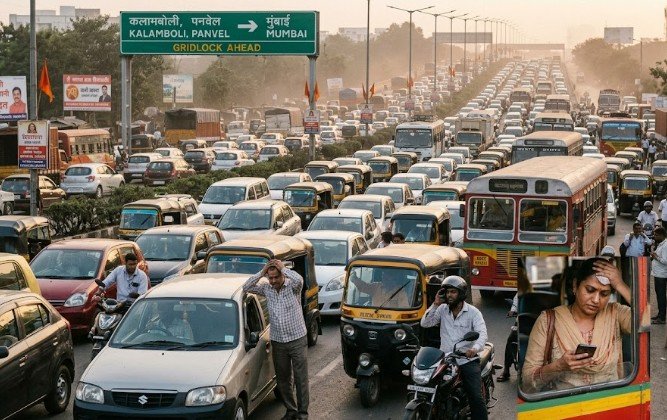
Heavy vehicles and ongoing infrastructure work slow traffic at one of Navi Mumbai’s busiest junctions.
The Jam
Traffic congestion at Kalamboli Junction has become a growing concern for motorists, with long queues and slow-moving traffic affecting commuters travelling through the area.
Kalamboli is an important connecting point for vehicles heading towards Mumbai, Pune, Panvel, JNPT and Uran. The junction handles a heavy mix of cars, buses and container trucks throughout the day. The increasing traffic volume has frequently resulted in delays, particularly during peak hours.
Ongoing infrastructure work around the junction has added to commuters’ difficulties. Diversions and changes in traffic movement have narrowed available routes in some stretches, making the daily journey more time-consuming.
For many commuters, a trip that normally takes a short time can now stretch considerably longer. Truck movement and vehicles merging from different directions further add to the pressure at the junction. Authorities are working on a major improvement project aimed at easing the situation. The plan includes flyovers, an underpass and a multi-level interchange that is expected to improve traffic movement and reduce dependence on signals once completed.
In the meantime, commuters are hoping for better traffic management and clearer diversions to reduce the daily inconvenience. With Kalamboli continuing to handle increasing traffic from several major highways, the junction remains a key focus for efforts to improve connectivity and ease congestion in Navi Mumbai.

Housing Sales Dip Across Major Cities, But Navi Mumbai Bucks the Trend

8,573 Ganesh Idols Immersed Across Navi Mumbai on Anant Chaturdashi

Traffic Jams Leave Kalamboli Commuters Frustrated

Nidhi Razdan, fake Harvard professorship, and here is the explanation through her blog.

As the arrangement with Prashant Kishor falls through Rahul Gandhi has gone overseas again and is uncontactable

BSNL reveals all new 4G plans starting at ₹16

-
 Fact Check6 years ago
Nidhi Razdan, fake Harvard professorship, and here is the explanation through her blog.
-
 India4 years ago
As the arrangement with Prashant Kishor falls through Rahul Gandhi has gone overseas again and is uncontactable
-
 Technology5 years ago
BSNL reveals all new 4G plans starting at ₹16
-

 Latest News5 years ago
Tata wins Air India with ₹18,000 crore bid
-

 Latest News5 years ago
Government has spent ₹9,725 crores on Covid-19 vaccination drive so far
-

 Latest News5 years ago
Jharkhand government cuts Petrol price by massive ₹25 a litre but with a catch
-

 Latest News5 years ago
Raj Kundra Gave ₹25 Lakh Bribe to Mumbai Crime Branch to Avoid Arrest
-

 Navi Mumbai5 years ago
Navi Mumbai civic body raids and tests morning walkers, many found COVID positive